The Royal Princess
No, not Princess Hina, but the cruise ship from Princess Lines. There is no question in our minds that at our age, the best way to visit this archipelago is by cruise ship. There is an air-conditioned stateroom to repair to at any time of the day; there is an abundance of food included in the passage price; there is no daily packing and unpacking as you visit the different islands; there is entertainment, good books to read, a sheltered deck to work on your tan and, in the case of the “Royal Princess”, Douglas Pearson, a master storyteller, who would regale us with engaging tales of the islands, astronomy, and many other useful and useless items of interest.
We had booked a ten-day cruise, which would be 9 nights on the ship. Starting in Papeete, the itinerary included Rangiroa, Huahine, Raiatea, Bora Bora, Moorea, and then back in Papeete. Tahiti and the last four islands are part of the cluster of “Society Islands”. Rangiroa, much further away, is part of the Tuamotu Islands.
.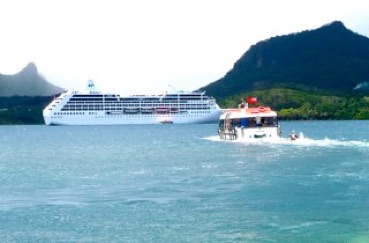
right: the mv. “Royal Princess” in the Baie de Maroc, Huahine, with a tender in the foreground.
As cruise ships go, the mv “Royal Princess” is actually a small ship, only 180 meters long and 25.5 m broad, with a maximum draft of less than 6 meters. It has 4 diesel electric engines with a total output of 13,500 kW @ 720 rpm. On our trip we had some 680 passengers and a crew of 350 on board. The cruising speed is 20 knots, but we often sailed slower. The ship was under the command of Captain Ivan Jerman.
To visit these islands you actually cannot have a larger ship, because the few entrances in the coral reefs surrounding the islands are very narrow. In addition, the lagoons are not deep. Even with this small ship, most the time we had to anchor in the middle of the lagoon and tendered ashore.
There is a cruise ship, which plies these waters regularly; it is the mv “Paul Gauguin”. She is smaller than the Royal Princess, with a passenger capacity of around 300. But the Gauguin is more luxurious and substantially more expensive. Passengers on the Gauguin no doubt sneer at the plebeian Royal Princess, packed with unrefined, vulgar peasants on their cut-rate holidays. Wouldn’t you, if you were on the “Gauguin”?.
Rangiroa.
Even though Rangiroa was north-east of Tahiti, we had to get to the north-west side of the lagoon to enter the “Passé de Tiputa”, one of the two main entrances in the coral reef barrier. There is a third, shallower entrance. As I mentioned earlier, the island in the middle of the coral circle had already disappeared under the surface of the water, and only a large lagoon is left. This lagoon is so large that from one side of the coral barrier, you cannot see the other side, because it is well beyond the horizon. This vast inland sea is some 46 miles long and 16 miles wide, which makes Rangiroa the largest atoll in the Southern Hemisphere. Only about 1400 residents live here so, with the Royal Princess around, the population is almost doubled. Everything there started out as the coral reef; if you see large rocks or stones, they have been imported from somewhere else.
The lagoon of Rangiroa is world famous for unsurpassed scuba diving in the warmest and clearest water you can imagine. The most favorite excursion is “shooting the pass”, going in with the currents through either of the passes in the ring of reefs.
From our experience in the Bahamas, we decided it was not necessary to book trips in advance from the ship. You could always go ashore and find a local tour operator willing to offer you the same trip at a much reduced price. This doesn’t always work well in French Polynesia. Tourist traffic is not high, and cruise ship arrivals are infrequent. In the more popular places like Raiatea and Bora Bora, there are local operators offering a variety of tours as you step on land. In other islands, there is very little or none, so it is advisable to plan ahead.
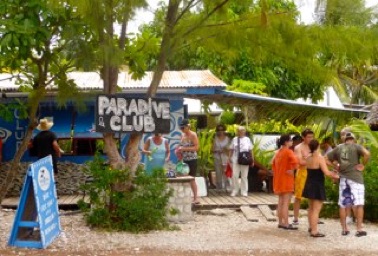
left: The Paradive Club dive shop in Rangiroa.
On the pier in Rangiroa we found a café, a few houses, but luckily also a dive shop, offering snorkel tours for CFP 4000, which is equivalent to $45. They also take US dollars, but then the rate goes up to $50. We found in many places it was less expensive to pay in local currency, which you pick up at any ATM. One interesting thing I found was that the Banque Socredo allows you take as much as the equivalent of $1000 each time. Other banks have much lower limits, just $200 - $300 or so. And branches of the Banque Socredo are everywhere.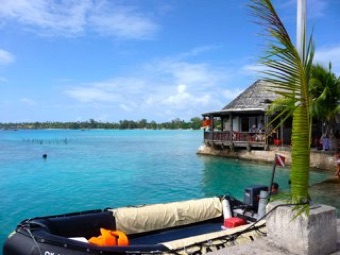
right: From the pier in Rangiroa.
A zodiac took us a few miles out to an area called “The Aquarium” and there we spent some time snorkeling around looking at the myriad of different-colored fish around. The water was clear and I even saw a large Moray eel, maybe two feet long. Back at the quay and the dive shop we saw a bus offering a free ride to the local pearl farm. Which we took and which took us to the pearl farm, some 10 miles away. We were traveling on a narrow strip of land, very sandy with water on both sides, the quiet lagoon on one side and the open ocean on the other side. There were shrubs and there were coconut trees; not much else. The farm was the standard type pearl farm and they also sold pearls, of course. The quality of their pearls was actually quite good.
Huahine.
The next morning we left for Huahine, a day sailing away. On our journey we passed Makate on starboard, a 24 sq mi island, which had been uplifted from the sea, with steep cliffs rising up to 80 m on some places. There used to be a town there, called Vaitepaua, but it is now deserted. In the middle of the 19th century it was a busy place, as phosphate was mined by hand on the island.
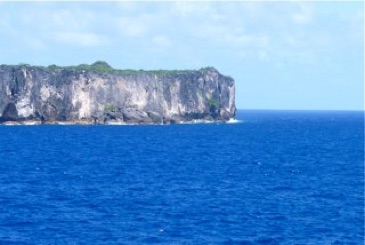
left: The steep cliffs on the north of the island of Makate. Phosphate used to be mined here.
The local Polynesians sneered at this manual labor, so the owners had to import workers from China, Japan, and Indochina (now Vietnam). Most of these workers went back home, when the mine closed.
One interesting fact was that the local natives placed their dead in coffins, which were then placed in horizontal holes in the face of these steep cliffs, high up in the air.
At Huahine, the Royal Princess had to maneuver through the a narrow opening in the reef to get into the Baie de Maroc, between Huahine Nui and Huahini Iti. These two islands are connected to each other by a bridge over the narrow channel. On the other side of this channel is the Baie de Bourayne.
At one time the two islands were connected to each other by a narrow piece of land. But one day, Hiro, the great Polynesian warrior and God of Thieves, plowed through this piece of real estate in his great war canoe, forming the channel. He must have wanted to go to the bathroom badly on the other side of the bay and this desire created the extra umpff to slice through the land. To show how he was able to do this, there is an etching of his huge paddle and a fish hook on a large vertical rock. As you enter the Baie de Maroc, the rock is on the right. The paddle was at least several meters long.
When Hiro decided it was time to join his ancestors, the locals reverently placed his manhood on the hill across the channel, on Huahine Iti. Over time it has petrified into solid rock, and now you can see the rock which, with a bit of imagination, is in the form of a phallus. albeit on the stubby side. This rock is called “Ure o Hiro”, which translates to the “Penis of Hiro”. He must be some guy.
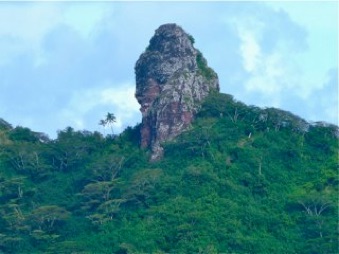
Except for a small hut selling pareas and tourist souvenirs, there was nothing else in the docking area. There was Le Truck, which was the local bus, which took us, for $5, to Fare, the main town on Huahine Nui, some 15 miles or so away. On arrival there was a small restaurant and some shops, with a few people milling around, as well as the main pier for the local boat traffic. The biggest building of the city seems to be the public toilets on the beach. You do have to get your priorities right.
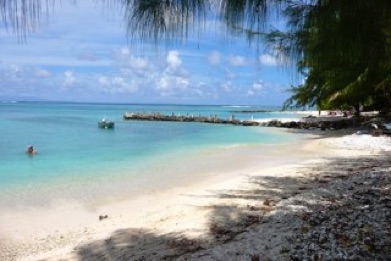
left: The beach close to Fare in Huahine.
So we walked for about half a mile along the beach until we found a place where there were more people sitting in the shade or swimming or snorkeling in the clear water. We waded a bit in the water, because we didn’t have our swimming gear with us. And then had a picnic lunch of sandwiches which we had taken along from the cruise ship.
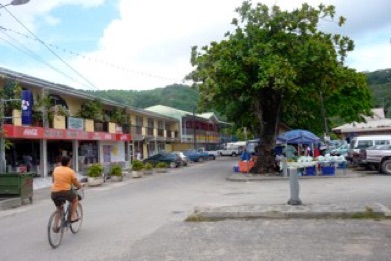
right: The main street of Fare, the capital of Huahine. Behind the tree is an open air market, there are shops on the left.
The town was not more than a street long. It was a quiet and relaxed place. There was an internet café, but just before we planned to enter the place, the shutters went down for the afternoon siesta. You have to get your priorities straight.
The market was still open, as well as a supermarket. Nothing much to do. So we just took the bus back to the boat. There were one or two tours available that day, but when we arrived, they had already left. But Huahine does look more laid back and more quiet than e.g., Bora Bora.
There is actually much more on the island, which we missed; tropical gardens, maraes, diving and snorkeling sites, a pearl farm, a private picnic luxury cruise, etc., most of them eerily similar to those you’ll find on the other islands. The jaded traveler could say that once you’ve seen one, you’ve seen all. Well, tell that to Casanova.
The Royal Princess left Huahine for Raiatea in the late afternoon. The ship had to use its bow thrusters to be aligned in just the right direction in the Bay before moving out through the very narrow channel in the reef. The channel markers were not more than a feet on each side of the vessel as she sailed out to open sea. No wonder large cruise vessels cannot visit here.
Raiatea.
The “Royal Princess” made her entrance through the Passe Teavapiti in the early morning and then proceeded to her berth. This is the only stop, besides Papeete, where no tenders were required.
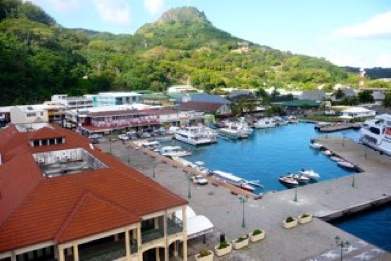
left: The harbor of Raiatea
The ship was moored right against the dock and after we disembarked, there was a building right on the quay where several tour operators were busily hawking their trips. We chose one, with a pretty decent itinerary, comprising of a fish farm, a vanilla plantation, the river, a pearl farm, and a swim. It was priced at $50, but he accepted CFP 4,000, which was around $45. The trip was on a 30 passenger motored barge all along. One of the passengers insisted that we visit the Marae Taputapuatea, and the captain/guide reluctantly agreed. That was lucky for us, because this marae was a very important place. But during the trip the guide suddenly said that the pearl farm was closed that day. That was a white lie, because we found out later that the farm was open. But we were quite happy with the exchange, because we had seen enough pearl farms by that time.
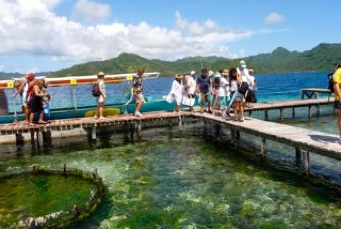
right: A fish farm on an island between Raiatea and Tahaa
The fish farm was small, on a small motu (island). Here we were offered fresh papaya and coconut juice for refreshment. They only has a few ponds and there were turtles in one. The vanilla farm was half an hour further away on the island of Tahaa, which is north of Raiatea. Growing vanilla beans is a very labor-intensive process and the yield can swing wildly up and down, dependent on many factors. The farm is organic, i.e., the plants are not in a hothouse, but outdoors on the slopes of a hill. Because there are no bees in Tahiti, these plants have to be pollinated manually, early in the morning.
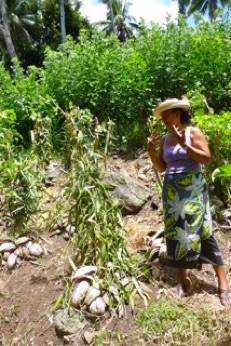
left: On a small vanilla plantation
The vanilla plant is actually parasitic and lives best on a mature acacia tree as the host. This particular factory produces about 6-10 tons of vanilla/year, and is run almost singlehandedly by a woman in her forties. She offered us fruits and drinks and there was a small gift shop carrying vanilla and related products, as well as the usual products in the tourist trade. Life can be hard, even in Paradise. The young kids nowadays don’t want to work hard; they want the easy life.
From there we motored to the Faaroa river, which is the feed to Tauroa Bay, an extremely interesting topological phenomenon. Imagine, these islands are very hilly, with tall mountains around. Water falls down along steep rivers and streams directly into the lagoon. But here is a river, where the water flow and the level drop are both very low.
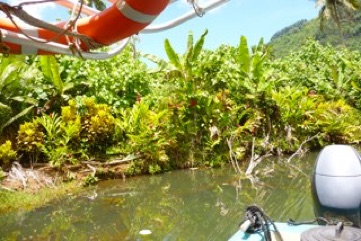
right: lush vegetation on the banks of the slow-moving Faaroa river.
What you get is a slow moving, fairly shallow river like what we saw in the tropical rain forests of the Amazon, with dense foliage, trees, and flowers on the banks. But this river is only 200-300 meter long and therefore aptly named the Faaroa, or the “Long River”. For their topography it was a long river.
Then we motored to the Marae Taputapuatea in Opoa, an awesome place of platforms and other open structures made from black volcanic rock. Raiatea was considered the most sacred of all of the Society Islands. The chiefs of the Allied Kingdoms of Polynesia used to journey by canoe to hold tribal meetings and ceremonies at this Marae on the southeast side of the island. It was considered the religious center of Eastern Polynesia.
At one time human sacrifices must have been performed here, because thousands of human skulls were excavated in 1969. By 1000 AD the marae was already established and significantly expanded over time. It fell into disrepair and disuse after the missionaries succeeded in saving all the available souls 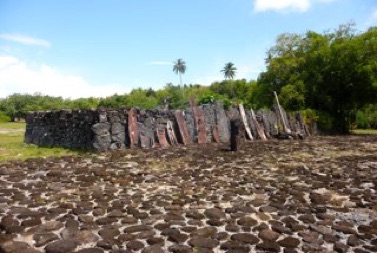 in the area. So it fell on the archeologists to restore the site. And that they did, starting in 1994.
left: Note the black volcanic boulders used to build this marae.
There were only a few visitors around when we arrived there. It is now a sad and somber place, with the ghost of the memories of temple drums and the dancing population faded away into eternal silence.... One can easily imagine the chiefs in elaborate garb presiding over meetings, feasts, and sacrifices, singing, talking, and arguing with each other..... Here was history; but here history is no more.
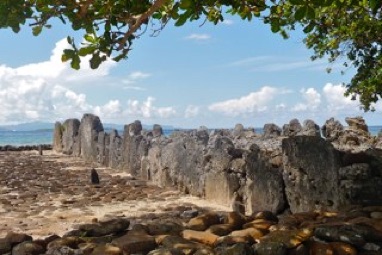
right: Another area of the Marae Taputapuatea
The tour boat took us to an island close by. It was clearly uninhabited, but it had bathrooms, outdoor showers with tap water, a big open building with a thatched roof, BBQ pits and picnic tables. So we stayed there for an hour and swam in the clear waters looking for fish in the small clumps of coral on the sandy bottom. About a quarter of a mile from shore was a helicopter, which had plunged in the water and is now resting there, in not more than a few feet of water.
It took us another half hour to get from there to the Princess. It was a good day.
We left Raiatea later that night and proceeded to Bora Bora, where we arrived early the next morning.
Bora Bora.
Bora Bora is undoubtedly the crown jewel of the islands. It shimmers like an emerald, set in the iridescent turquoise and aquamarine waters of the lagoon, encircled by the reefs like sparkling pearls in a necklace. It is a wonderful place to stay and to enjoy the luxurious surroundings, especially if you have lots of money to spend. The rich and famous come here for their holidays and cheerfully pay the inflated prices all around.
We had met Wendy Hebert on the ship; she and her mother were the only Polynesian passengers on the ship; she lives on Bora Bora. Wendy owns Arc en Ciel, a small shop where you can get good pearls at very good prices, this according to Wendy herself. And she will affirm that with her charming, attractive smile. We actually did buy a pearl necklace from her. If you cannot trust her, who else can you trust?
When we told her we were planning to rent a car for the day, she asked why we wanted to do that. The road around the island is only 25 kms long and you could rent a bicycle and make the circle trip yourself in 2 hours or less.. So she called her good friend Dora, who has a big taxi, and big Dora said she would give us the island tour plus commentaries for $35/pp.
There are some nice hotels on the island; we stopped at the Sofitel for a look at their layout and also to pee. The Sofitel is very nice but the newer and more expensive resorts are on two large motus on the reef across the lagoon. They are the Four Seasons Resort, the St. Regis, Le Meridien, and the Intercontinental Thalasso Spa. To the north, on the Motu Mute, is the airport, so you need a boat to get to any of the islands. Many tourists at these resorts stay there and don’t even bother to go to the island, because a round-trip from their resort to Vaitape, the capital, on the main island, is $35. And life on the island is really several rungs lower than in the resorts.
Almost all of the land belongs to the local Tahitians, and are passed from generation to generation. This makes it difficult to determine ownership because at death a parcel is split between the kids, and so on, and so on. Ownership of a property also includes the beach, so beach access in Bora Bora for the public is limited. There seems to be only one large public beach, Matira Beach, in the south of the island and a taxi/bus will take you there from Vaitape for $5.
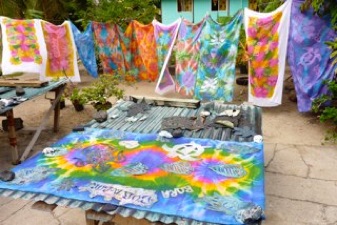
left: A cottage industry where pareos were dyed by hand.
We stopped at a place, where they made pareos and where the colorings were applied by hand. They also offered us an extensive buffet of fruits and other local dishes.
We stopped to look at land crabs scurrying around. We stopped at Bloody Mary’s, a renowned restaurant because all the celebrities coming to Bora Bora come here. But the restaurant was closed for renovation. We stopped at other places to make pictures. We looked at the flora as Dora brings us up on the local gossip. And then we went to Wendy and her Arc de Ciel store.
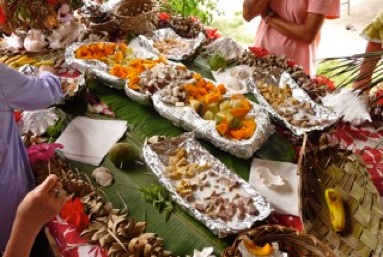
right: The pareo place offered a nice welcome buffet of local produce.
On this trip we passed the over water bungalow where Marlon Brando used to live in. You can now rent this luxury bungalow for $2,625/week. That is only half of what you pay per day in one of the better bungalows in the St. Regis.
Intertwined with Bora Bora are the stories of Marlon Brando, which you can find in Wikipedia and the pulp magazines. This one was told by Doug Pearson’s sister, who lived in one of the hotel bungalows in Bora Bora, when Brando was there filming the “Mutiny of the Bounty”. At that time he was accompanied by his then current wife, Movita Castaneda, who had actually appeared in the first “Mutiny of the Bounty” film in 1935. One morning, very early, there was a big hubbub and as Doug’s sister came out she saw Movita in a major rage throwing furniture from her bungalow in the pool. Marlon Brando was out that night again carousing with Tarita.
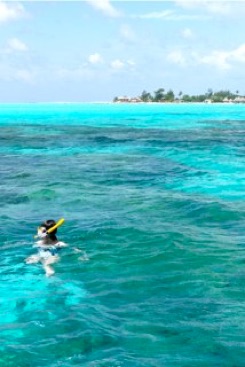
The next day we took a private tour from Moana Adventure Travel. We stepped in a Boston Whaler and Rapa, our guide/captain/cook motored us around the island, pointing out the over water bungalows of the expensive resorts from close by. Some of the big luxury bungalows have indoor swimming pools with fresh water, glass floors where you can admire the lighted coral gardens and the brilliant-colored fishes underneath the bungalow, and other “minor” amenities.
We stopped in an area with a lot of fish, especially since Rapa had thoughtfully taken a bucket of fish entrails along as chum.
right: snorkeling in the azure lagoon.
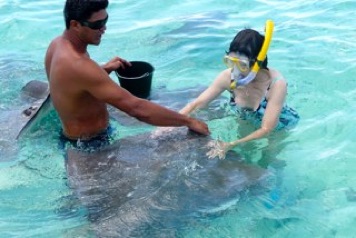
. We snorkeled for about 30 minutes before we motored to another area, about 3-4 deep, where we swam with huge manta rays and sharks. The rays like to be stroked and you can feed them, if you wish. They have no teeth and the food is sucked in their mouth.
left: playing and feeding the huge manta rays
From there we went to a private motu, where Rapa set up a table for two under an umbrella in the shallow waters of the motu. He then proceeded to make lunch. It was a copious 4-course lunch, starting with a shrimp salad, then the main course, which was a wonderfully prepared BBQ of freshly caught mahi mahi, chicken, and beef, a post-course, which was a superb carpaccio of tuna freshly caught the day before by some of his friends. This dish is very popular here and known as ei’a ota or poisson cru.
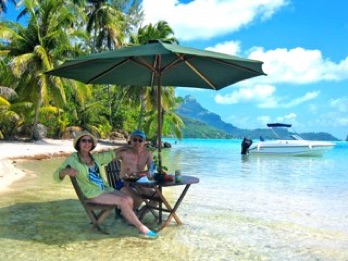
right: 4-course catered lunch in the water off a private motu (island) in Bora Bora. The Boston Whaler is in the background.
Fruits for dessert. There was nobody else around and the iridescent water was shimmering in turquoise, jade, emerald, aquamarine and other colors of the rainbow. It is difficult to adequately describe the beauty of the scene.
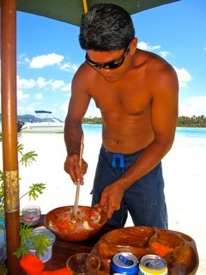
left: Rapa preparing the tuna carpaccio.
We chose this trip, which was top-rated in TripAdvisor and which we had booked earlier from Moana Adventure Travel by internet. This was “The Honeymoon Tour”. Maybe because it was so expensive. We paid over $600 for this 5-hour adventure, but we found out later that a similar tour booked through a hotel or local travel agent would cost 20-30 % more. Add a few minor touches and the price goes up another 50 %. Paradise is not for the penurious.
However, at the same time we were there, Moana Adventure Travel was also hustling passengers from the cruise ship to go with their separate tour for $70/pp in a larger boat with 10-20 passengers, same snorkeling and swimming with the mantas and sharks, and a private motu (not the same as ours) for swim but no catered lunch. Well, times are hard, so even they had to cater to the unwashed masses.
IV: The mv “Royal Princess”
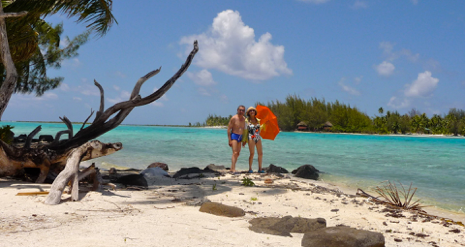
A Loaf of Bread beneath the Bough, a Pink Umbrella - and Thou, Beside me singing in the Wilderness - and Wilderness is Paradise enow -
from the Rubaiyat of Omar Khayyam