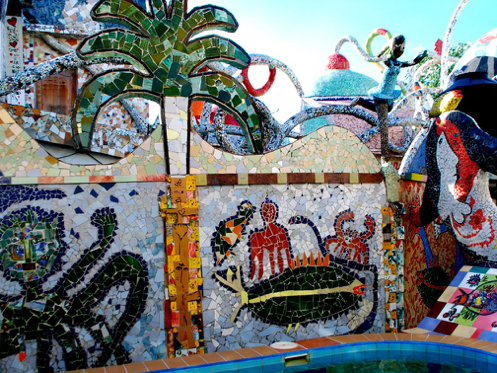
A Day in Havana

A Day in Havana
“No te salva ni el medico chino”
This is what they used to say in Cuba about Cuba: “The problem is so insurmountable, that even Chinese medicine cannot cure it”. This may sound funny, but at one time the Chinese were an important component in the history of Cuba.
Cuba was in dire straits a few years ago. But today Cuba is alive and vibrant. It is now the destination of choice for many tourists, as they come to enjoy the charm of Old Havana, the music, and the history off the country. And although there is still a lot of poverty, there are clear signs of improvements.
Havana, the capital of Cuba, was founded more than 500 years ago as a Spanish colonial city. Spanish colonial architecture is everywhere. It was a city where once the beau monde gathered, where wealth and style were flaunted by the rich and (in)famous, the stars and the gangsters. In the nineteen fifties, the city was producing more revenue than Las Vegas. But since then it has undergone periods of extreme hardship, from which it still has not quite recovered.
But its unique charm is still there, especially in Old Havana, where picturesque streets, historical plazas, old Cadillacs and the sounds of Salsa and Meringue abound to enchant the visitor. Many of the colonial architecture, with its colorful yet crumbling facades, are undergoing extensive renovations these days, to revive some of the former splendor. When Fidel Castro came into power, many of these magnificent palaces were abandoned by the rich in their hasty flight to Florida. Many of these have been modified to have multiple one bedroom apartments to house the poor. Clean and well maintained, the inhabitants are still poor and unable to make costly repairs and invest in beautification projects. Even though everyone is well-dressed, there are still very many poor people living there. If there are homeless people there, we didn’t see them.
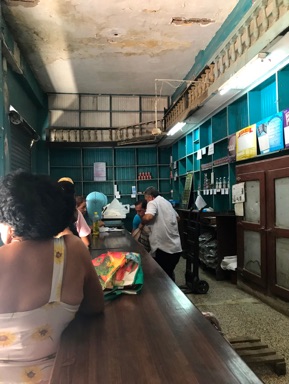
The Government instituted a rationing system, still in use today, where poor families are issued coupons to buy small rations of soap, bread, food, and other necessities for very little money. It helps, but it is not sufficient for all their needs.
left: Inside a rationing store.
You can see that the shelves are mostly bare. Locals come here to exchange their coupons for supplies.
1: Abbreviated History
In the 16th century the Spanish founded the city of Havana. The location was strategic, and it was used as the springboard for the Spanish conquest of the Americas. It became the stopping point for the treasure-laden Spanish galleons returning to Spain.
In 1592 Havana was granted the title of City by King Philip II of Spain. Walls as well as forts were built to protect the old city. The sinking of the U.S, Battleship Maine in Havana's harbor in 1898 was the immediate cause of the Spanish-American War
In the early half of the 20th century the city and country prospered. It was the the golden age, where money was made by connections, corruption, gambling and sex. Luxury hotels, casinos, and nightclubs sprouted up, making the rich richer. And above this was the corrupt president, Bautista, who also profited from the sugar plantations. Little trickled down and the poor and disenfranchised.
The upshot was the revolution of 1959, where the new régime under Fidel Castro promised to improve social services and public housing. Fulgencia Batista, who had ruled with violence and fear, his henchmen, and the rich, who had profited immensely during Bautista’s tenure, fled Cuba. Most of them settled in Florida. With their money, they were a powerful political force with their main goal of opposing Castro to get Cuba back in their hands.
Castro’s regime expropriated almost all private property and industry (May 1959 onwards) under a strong communist model backed by the Soviet Union. These included the small stores owned by the Chinese. This was followed by the U.S. embargo, and shortages affected Cuba in general. During his visit to Cuba, president Obama promised to lift the embargo, but he ran into strong opposition from the Republicans, fueled by money from the Cuban enclave in Florida. The current administration of president Trump intends to preserve the embargo.
A severe economic downturn occurred after the collapse of the Soviet Union in 1991. Soviet subsidies ended, representing billions of dollars which the Soviet Union used to give to the Cuban Government. Many believed that Havana's Soviet-backed régime would soon vanish, but Havana’s communist régime continued to survive by dint of hard work and the creative ability to recycle almost everything.
After many years of prohibition, the communist government turned to tourism for new financial revenue. Foreign investors were allowed to build new hotels and develop the hospitality industry. In Old Havana, efforts have also gone into rebuilding for tourist purposes, and a number of streets and squares have now been rehabilitated. And Cuba is now the place to go, to wonder at past glories, to marvel at the resiliency of the population, and to enjoy the many things they now offer. The music, the salsa!
2: The Chinese in Cuba.
There is a Chinatown in Old Havana, also known as the Barrio Chino. Starting in 1857 hundreds of thousands of Chinese workers were brought in from China, Hong Kong, Macau, and Taiwan during the subsequent decades to replace and/or work alongside African slaves in the sugar fields. The Chinese usually had 8-year contracts, but there were almost no women with them. Most if the men did not marry, but there were some marriages with black women. In the 1920s an additional 30,000 Cantonese arrived. These immigrants were also all male. After they finished their contract, most of these immigrants went back to their original homes, where many had left wives and children behind. Others stayed behind in Cuba and made a living operating small enterprises, such as restaurants and grocery stores.
But when the new revolutionary government led by Fidel Castro came to power in 1959, the economic and political situation changed. Many Chinese grocery store owners had their properties expropriated by the new government. Many left Cuba, particularly to nearby Florida. But it was not easy to leave Cuba, when Fidel Castro was in power. Many of their children are called Cuban-Americans of Chinese descent.
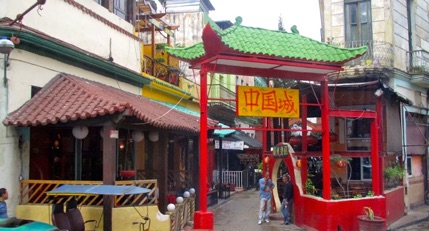
right: One entrance to Chinatown. The sign in Chinese says China City.
There is still a Barrio Chino in Havana, but the number of Chinese living there is small.
Most Chinese Cubans live outside the Barrio. According to an unsubstantiated source, there are only about 400 Chinese living in Cuba. Which sounds awfully low. I think this number is incorrect. Currently there is a growing number of Chinese-owned small enterprises, such as beauty parlors, mechanical shops, restaurants, and small grocery stores in the renovated Barrio Chino.


Blog Summary Widget