Corsica

Corsica.
October 2 - 9, 2016
Corsica (“Corse” in French) is an island in the Mediterranean, mostly known because Napoleon Bonaparte had the good taste of being born there in 1769. Providence chose his ancestral home in Ajaccio, the capital of the island. That building is now a museum. A few miles outside the city limits of Ajaccio is the aptly called, and fairly busy, Napoleon Bonaparte airport. EasyJet flies here, disgorging hordes of tourists from Europe, with a large percentage from the Netherlands. The island is southeast of France and north of Sardinia. It is one of the 18 “regions” of France, but it does enjoy a larger degree of autonomy than the other regions in the country. And there is a strong undercurrent of desire of the population to secede from France to become independent again. After all, they were an independent country once before France conquered them just some 250 years ago. It is not clear whether for Corsica it is lucky that Napoleon was born there. Even though he neglected the island when he was emperor of France, his stature created an important tie between Corsica and France.
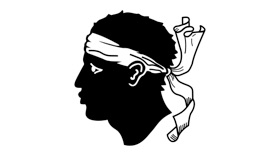
left: This is the flag of Corsica, adopted in 1755 by Pasquale di Paoli, the leader of the independent nation of Corse. It is based on a traditional flag used previously of a head of a Moor with a white bandana covering his eyes. Paoli removed the bandana from the eyes to symbolize the liberation of the Corsican people.
The flag was banned after 1769, when France conquered the island, and in the early decades of French rule, the Corsican patriots used the blindfolded version as a mark of protest.
If you are an obvious foreigner and a tourist to boot, and you speak French with the locals, not necessarily fluently, the natives are very hospitable, kind, and helpful. You are, after all, helping their economy grow. If you insist on speaking English only, they may just ignore you and you may not get much service or smiles as result. Partly this is because they don’t speak much English to start with (well, this is not really a well-traveled section of the world) and partly because it is their stubborn feeling of independence. There was an entry in TripAdvisor recently where a restaurant in Corsica was being bashed by a contributor, because he received very poor service even though he made all his requests nicely in good English. Some people never learn.
But just speaking French is not enough; if you are an obvious Frenchman from France, you may occasionally not feel a welcoming breeze around you also, because they see you as an interloper and a specimen of an oppressor against their independence. I spoke to a Frenchman recently who had visited Corsica and he said he could feel hostility, because they can catch from his accent that he is French from France. He once went into a bakery and they didn’t want to sell him any bread, telling him that all the bread in the store had been reserved. And yet, when he was still in the store, the baker was still selling bread to locals as they come in. They obviously have not made any reservations for the bread either.
I have the feeling that there are more tourists in Corsica from abroad than from France. Surprisingly, a large percentage of the foreign tourists come from the Netherlands. They are usually young and gravitate to the many, some of them very nice, beach resorts. They could, of course, have gone to the southern coast of France, but Corsica is more primitive and less expensive. Club Med is big here. And the Mediterranean weather in Corsica is touted as being wonderful most of the time. We did get caught in a terrific downpour once, of course when we were walking in the open away from shelter.
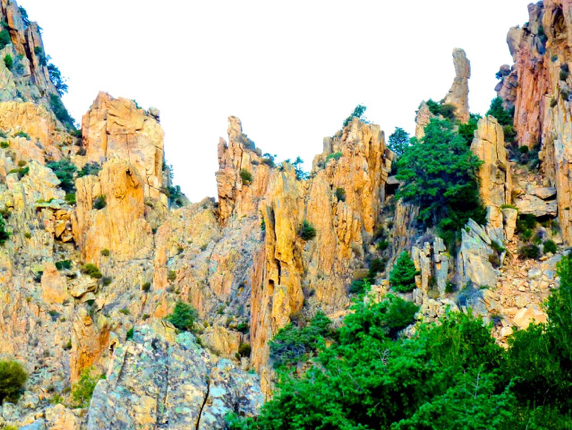
The island is divided in two “departments”, Haute Corse (Northern Corsica) and Corse-du-Sud (Southern Corsica). The island is quite mountainous, with mountains along the spine of the island more to the West. The western part of the island is where most of the mountains are; here the roads are curvy and driving is slow. The problem is exacerbated because this is the most scenic part of the island, and giant tourbuses on these small roads can really clog up the traffic.
The eastern part of the island, on the other hand, is relatively flat, with good, fast, freeways. Corsica was briefly an independent Republic until it was conquered by France in 1769. It has many historical ties with the Italian peninsula, so the island retains to this day many elements of the culture of Italy. The northern variant of the native Corsican language is closely related to the Italian, so I suppose you could get along quite well there with Italian, if you get tired of having to speak French all the time.


Blog Summary Widget