The Caribbean Pond

I: Grand Turk, San Juan, St. Maarten, and Half Moon Cay
I: The “Westerdam”
Holland-America Line had a sale going. There is a lot of competition for the Caribbean market and when we boarded the ship in Fort Lauderdale, there were six other cruise ships in port, including the behemoth “Oasis of the Seas”. We ended up paying $547 for a balcony stateroom on the 5th deck for this 7-day cruise to the Eastern Caribbean with four ports of call. Taxes and port fees were $125.75 additional. The Government always wants their pound of flesh.
Taxis were busily shuttling passengers from their hotels to the various cruise ships in port. The people working for the cruise industry looked harried but happy, because now is the beginning of the tourist season and mucho money is to be earned.
The “Westerdam” accommodated 1848 guests on this trip, (she can carry 2125 guests) about one third of how many passengers can be crammed in the “Oasis of the Seas”. She had a crew of 800, a gross tonnage of 82,000, a length of 935 feet, a beam of 106 feet, and a draft of 26 feet. It was built in 2004 and renovated a few years ago.
The vessel has the trappings of an European ship, with muted colors and imaginative layouts of the public areas, which meant that you needed more days than usual to become familiar with the topography. There are meandering passageways, cozy nooks, and nice pictures, drawings, and artifacts on the walls, on stands, or in vitrines, most of them celebrating the rich maritime heritage of the Netherlands. They must have had a good interior decorator for the interior of the vessel, who liked Art Deco. Layouts are unusual, such as the main pathway going through an expensive jewelry store. It doesn’t hurt to be exposed to jewels and emeralds, you might be tempted sooner or later to purchase a bangle or two. And many of the passengers are rich anyway.
And since most the passengers are also older, they were well-dressed and they observed the dress codes in the formal dining rooms. That doesn’t always happen in some of the other cruise lines.
The dining room staff consisted mostly of Indonesians, people where courtesy and hospitality are inbred through generations. And since we speak Indonesian, they were most attentive to our needs and desires. You would expect that in a vessel from the Holland-America Line the lingua franco would be Dutch. It is English because the crew is a hodgepodge of many nationalities. It seemed that the only officers who spoke Dutch was the captain, who was Dutch, and the Cruise Director, the guy who coordinates the passenger activities on the ship. And he was actually Belgian.
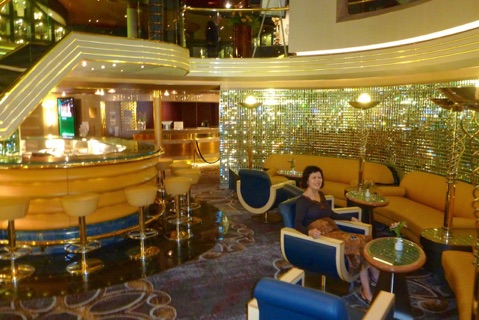
left: A place to relax and have a drink in the Art Deco style surroundings of the ms “Westerdam”
As for the entertainment, a small ship obviously cannot afford lavish shows, and the occasional comedians can vary from hilarious to insufferably bad. An effort for classy touch was the duo of Ukrainian piano and violin playing classical music in the evenings in one of the venues. But they were regretfully not very good because their pay was definitely not stellar. Or vv. I just can imagine these two women getting together one day trying to eke a decent living and then deciding to work as a duo with their average musical skills. They try.
What was nice was that the waiters do not seem to have to meet a quota of drinks sold. In the Princess Lines, e.g, you could sit down anywhere in a public area and a waiter is immediately there to inquire whether he can get you a drink. In the “Westerdam” the waiters go their own way. There is of course the inconvenience of having to flag down a waiter if your partner’s mouth is parched and just gasping for that Margarita. But that is minor. You save money by ordering fewer drinks this way.
The food was quite good, especially in the buffet on the top floor, the Lido, which is open almost all the time. One afternoon we just happened to amble by and picked up a nice cheese plate and a bowl of steamed clams, washed down with a glass of Australian beer.
II: Restaurant La Cirque
One evening we signed up for a special dinner catered by La Cirque, the uppity restaurant from New York and Las Vegas, at surcharge of $49/pp for the food, and an additional $20/pp for the wines, paired with the dishes served. We had been in the Las Vegas La Cirque once before, enjoyed the very good food and wine, especially because we were the guests of friends who insisted on picking up the tab. The food here in the ship was also very good. But the tab appeared on our final statement when we left the ship.
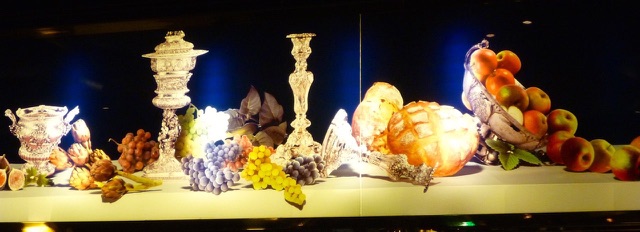
top: An illuminated painting in the dining room.
I had a steamed lobster tail with special dressing and Norma had a Trio of smoked salmon, paté de foie gras, and caviar, the latter very good and expensive stuff but not very imaginative. Interestingly, the next day we had lobster tails too with our regular evening meal, and we had to return the plate, because the lobster was inedibly soggy. It appeared that the ship had received a batch of lobster tails of inferior quality from Cosco, the large food purveyor, and many people in the dining room returned their lobster because of this. The maitre d’ was beside himself with this debacle. I suppose the La Cirque crew must have gone through the whole shipment to choose the very best for us the day before. .
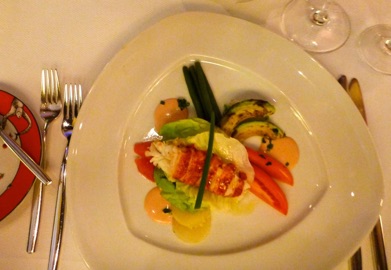
left: The steamed lobster tail appetizer.
Soup was butternut squash with cream, wonderfully tasteful and definitely fattening. For the main course I had the Chateaubriand; Norma had a completely defatted rack of lamb, which was a lot of work, but I would have preferred some fat for the pungent taste. There was a fluffy poached egg with no yolk. They had carefully removed the yolk prior to poaching the egg, resulting in a fluffy white egg.
All in all very enjoyable. And extremely courteous and efficient service.
III: Grand Turk, Turks and Caicos Islands.
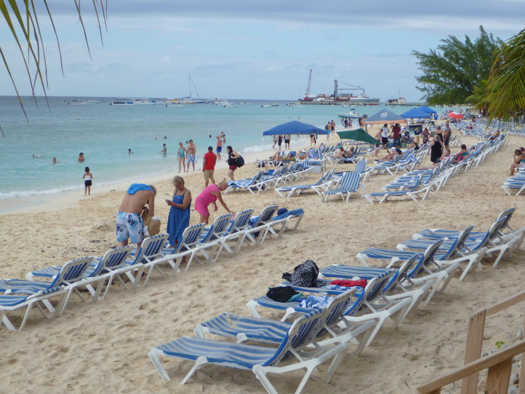
This small island in the Turks and Caicos Islands would still be in an extended state of somnolent tranquility, if the cruise ships had not come to them. Enterprisingly enough, they built a deepwater pier, allowing two huge cruise ships to dock there to present the passengers the opportunity to stream into town to disburse their money in a variety of possibilities. During these few hours, everybody’s pulse on the island goes up and everybody gets going. But as soon as all the cruise ships have departed, they go back to their much more comfortable lethargic style they are accustomed to. .
But the weather was beautiful, 78 ℉, slight breeze, and cloudy skies. Perfect, because the sun burns strongly. Next to us was the “Freedom of the Seas”, a ship of the Royal Caribbean Cruise Lines, about the same size as the “Westerdam”. The island has a population of around 4500, ruled by a governor appointed by the Queen of England. Below him running the daily chores is the locally elected prime minister.
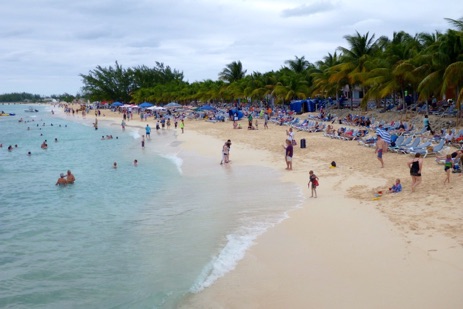
right: The usual Caribbean scene awaits the visitor
Immediately adjacent to the cruise ship pier there are beaches at the blue waters with inviting free beach chairs on the white sand, some of them in the protective shades of the trees. You can step out of your ship and be in the water in less than 10 minutes. The water is shallow and you can walk quite a distance on the sandy bottom of the cove.
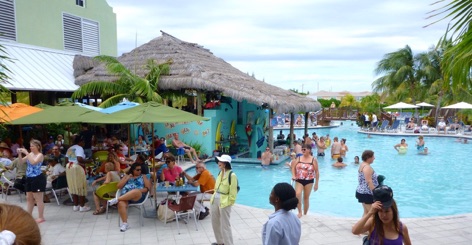
Or you can walk a few hundred yards further and you will enter the inescapable shopping complex packed with stores selling tourist mementoes and other dust catchers. But then there is also the Margaritaville restaurant, with a free swimming pool, live music, entertainment, and drinks galore at prices competitive to what you pay for drinks on the ship. A lot of passengers come here to enjoy the atmosphere.
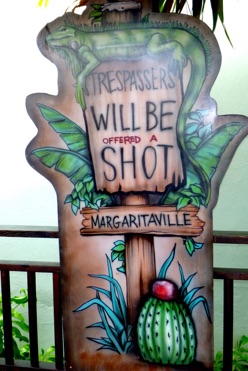
left: Welcoming sign for Margaritaville: “Trespassers will be offered a shot”
What most of these ports don’t have nowadays are internet cafes where you can rent a computer to check your mail and a zillion other things. The rapid rise of the computer tablets and smart phones have wiped them out. The cafes are still there, where you can get Wi-Fi access for a fee. But for this you need your tablet or portable computer. At speeds well surpassing the speed of the system on board.
below: The fun area of Margaritaville.
Stepping out of the shopping complex we took a bus to Cockburn Town, a small hamlet of a few hundred inhabitants, but which was also happens to be the capital of
the Turks and Caicos Islands. But in the car, the driver mentioned that 4 of the passengers would go on for an island trip, which we decided to join at the spur of the moment for a fee of $25/pp.
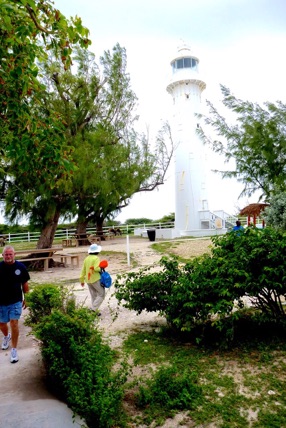
left: The lighthouse at the end of the island.
Swimming, snorkeling, and scuba diving are the prime activities on the island. The world’s third largest barrier reef is here. Outside the very hot summer months, people come here for a relaxing vacation with little else to do. The tour took us past salt ponds, which are not being operated anymore, but which used to be a main industry of the island. Drove through Palm Grove, a little hamlet of vacation rentals, passed the Community College, and finally ended at the lighthouse.
On our way back we stopped at a thatched hut fast food kiosk in Cockburn Town for a tray of 7 breaded and deep-fried conch fritters for $2 and a bottle of good local beer for $3. The museum looked interesting, with collections of artifacts from various shipwrecks, but we didn’t have enough time to justify the $8 entrance fee. So we missed the “Message in a Bottle Project”, recording nearly 40 years’ worth of messages which have washed on the shores of Grand Turk.
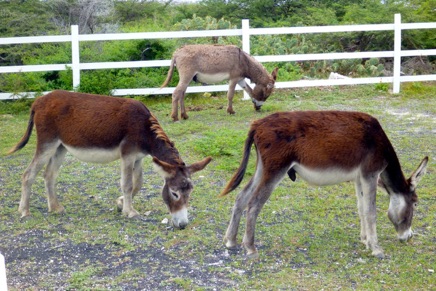
right: As in many areas in the Caribbean, there are large herds of wild donkeys around. They have been imported to work in the salt mines, but when the mines became mechanized and/or uneconomical, the donkeys were left to their own devices.
IV: San Juan, Puerto Rico
It was raining when we entered San Juan harbor, passing the 6-level high El Morro fortress on our left. The harbor has two piers parallel to each other, so four cruise ships can comfortably tie up there. But two is not enough; they were building a new pier between the two existing ones to increase their docking capacity another 50 %, and making the behemoths harder to dock because of the confined space.
After disembarking the people wanting to go on a city tour were herded into a line, where 24-passenger buses pick them up for a city tour at $20/pp. Very well organized here.
Puerto Rico is about 110 miles wide from East to West, and about 35 miles from North to South. Some 9 miles away is a deep trench on the bottom of the sea, 27,000 feet deep. The name of the town was coined by Ponce de Leon, who garnered so much gold here, and named the town the rich port. The population of the country is around 300,000, but they still manage to garner 5 Miss World titles over the years, placing them third behind the USA (8 titles) and Venezuela (6 titles). The main sources of income are: (1) manufacture of pharmaceuticals, (2) tourism, (3) agriculture.
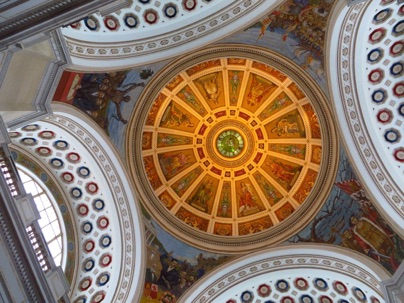
left: The cupola of the Capitol Building.
We drove around the new city, nothing extraordinary, but stopped at the Capitol Building, a grand structure constructed almost entirely of marble from different sources in the world. Tours stop here to allow the visitors access into the halls to gawk at all that marble.
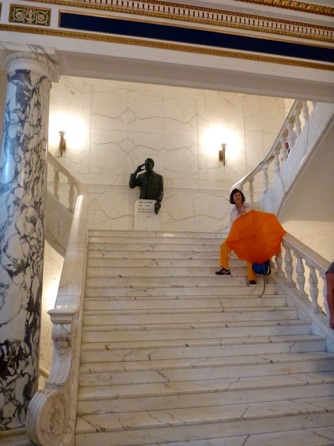
right: A marble stairway and column inside the Capitol Building.
The old town is pretty compact, narrow streets and commercial buildings, old. It is surrounded by 6 miles of walls. Walked inside the town and stopped at a store carrying butterflies mounted in artistic patterns. Mounted in oxygen-free plastic cases they go from $100 to several thousand $ each. Not cheap, but beautiful looking stuff.
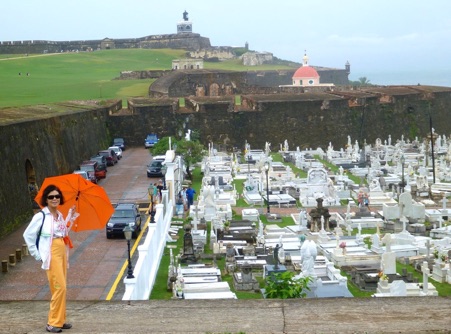
left: The Santa Maria Magdalena de Pazziz cemetery and the Castillo San Felipe El Morro fort in the background.
Puerto Rico also has a free trolley system for the benefit of the tourists. We waited for 30 minutes in the rain and no trolley showed up. So we don’t have a picture of the trolley. Maybe they don’t like wet weather. But it is a good way to get around the town.
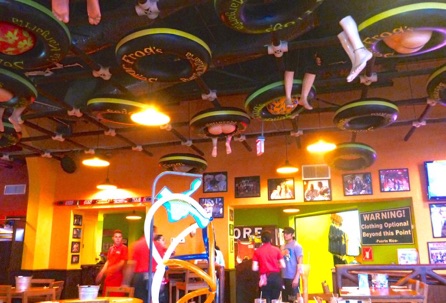
right: The interior of Señor Frog in San Juan harbor. The ceiling shows an “underwater” view of a group of people floating in rubber inner tubes on the water.
V: St Maarten
The island of St Maarten is only 37 square miles large, 16 square miles of which are Dutch and the balance is French. The official count shows 36 beaches and just as many casinos. Some 50,000 people live in the smaller Dutch section, but only some 35,000 call French St Martin home. Only a few people in Dutch St. Maarten speak Dutch. The upper crust yes, but the general public speaks English and Papiamento. Somewhat the same for the French section, but the French are proud of their language, so it is spoken more.
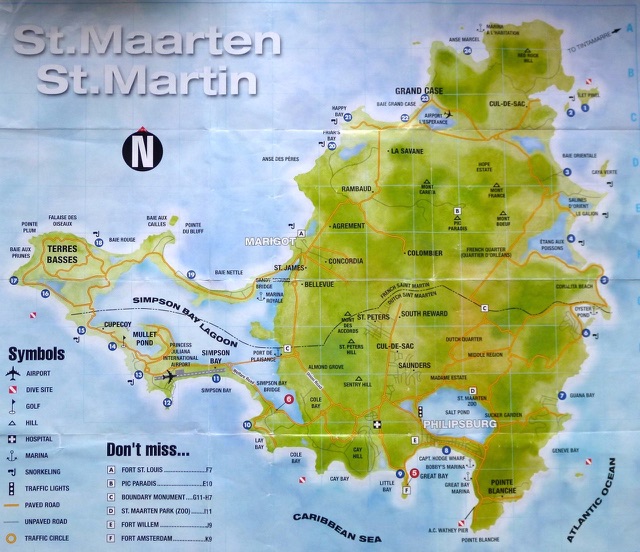
top: The demarcation line between the two parts of the is shown as the black line 2/3 down the island, marked C.
The unofficial version of the division is that, to determine who gets what, a Frenchman and a Dutchman walked in opposite directions along the coastline and where they would meet would determine where the demarcation line would be drawn. So off they went, the Frenchman with a bottle of wine, and the Dutchman with a bottle of Jenever (a Dutch schnapps) for fortification of soul and body. Since the wine only had one/third the alcohol concentration of the Jenever, the Dutchman had more trouble walking along the prescribed route. That is why, when they met again, the Dutch only had 16 and the French had 21 square miles.
Close to this island you can see not far away the island of St. Bart, or St. Bartholomew, a haven for the rich and famous and where everything is very expensive. A simple hamburger there costing $20 is quite common
Taxi tours of St Maarten are very well organized and you can get one as soon as you exit the cruise terminal building. Maria Langlois, our driver, driving her own 10 passenger air-conditioned van, was very informative as well as being very conscientious, stopping at every prescribed stop and not taking any shortcuts. While other taxis do the tour in two hours, she gave us three hours at no extra cost. If you need taxi services, you can call her at 599 587-9639 or 599 522-9639. Her e-mail address is taxi122@gmail.com and taxi122 is also the license plate on her van. She can give you a lot of tips on what to do on the island.
The island is a tourist hub. There were 5 cruise ships in port when we were there, so the roads were busy.
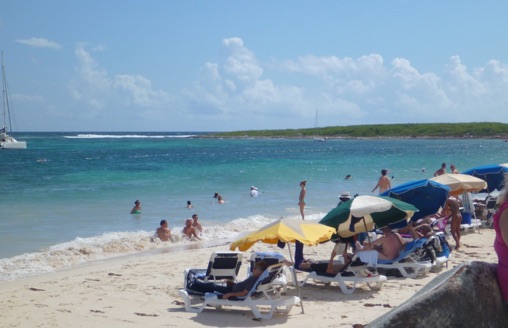
left: The Baie Orientale, shown as No. 3 on the map at north-east side of the island.
The ship terminal is on the south side of the island, marked f.
The tour took us along East Coast the to Baie Orientale, a clothing-optional beach in French St. Martin. The water is shallow and you can walk far into the sea. As usual, most of the nudes were men; but there were many women walking around topless. The sun was blazing hot and the colors were bright. The beach was packed and all the rental sun umbrellas were taken. Maria observed that today there were only American cruise ships in port (our ship was an exception). With more European ships in port, there would be more nudity on the beaches.
Our tour took us to Marigot, the capital of French St Martin, a cute little town, where we had lunch in one of the seaside restaurants. It was a stew of conch, surprisingly tender, with tasty rice. Creole food is good, if well prepared.
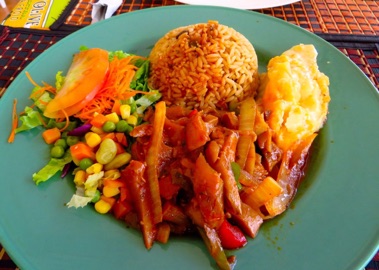
right: A tasty dish of stewed conch and accoutrements for around $10.
We also drove through Grand Case, a very long, narrow, one-way street parallel to the beach, where all the houses we saw were commercial, i.e., lodgings, bars, restaurants. shops, etc.
Most of the population is Catholic, but we saw a mosque where during the last hurricane the wind took one of the balls from their spire.
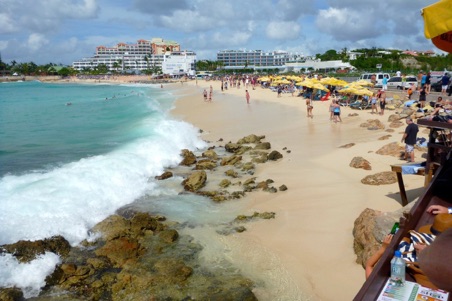
left: Maho Beach. The end of the runway is to the right of the yellow beach umbrellas.
We made a stop at Maho Beach, close to the end of the runway of the Prinses Juliana International airport, in the lower southwest corner of the island. Planes would stop here at the end of the runway to rev up their engines before taking off. The blast is sometimes so hard that it will blow people on the beach into the water.
So now there are cafes on the beach just away from the windy area, where people sit, drink, chat, and look at the list of airline departures. Then everybody stands up and watch the plane take off, but most probably also to see whether the jet engines blowing into into the beach would catch someone unaware and blow him/her into the sea.
Tourism is obviously the #1 industry. It used to be salt from the sea, but this industry is here not operational anymore similar to many other salt ponds in the Caribbean.
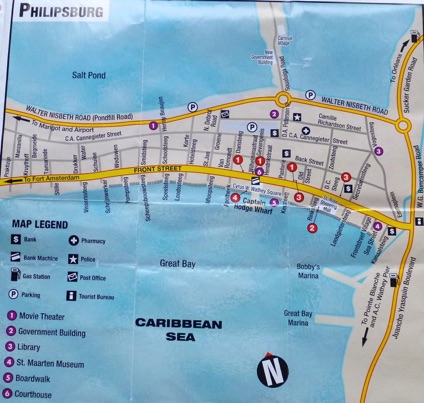
The capital of Dutch St. Maarten is Philipsburg, a narrow strip of land a few blocks wide, a shopping paradise with narrow streets, where you can buy stuff at about half the price of what you pay in Marigot. etc.
It is bordered on the north by the defunct salt ponds and by the Caribbean Sea on the south.
VI: Half Moon Cay, Bahamas.
The “Statendam” anchored in the bay and tendered the passengers to this “private island”, only accessible to Holland-America Line passengers that day. I presume the cruise line rents the facilities for private use for this day.
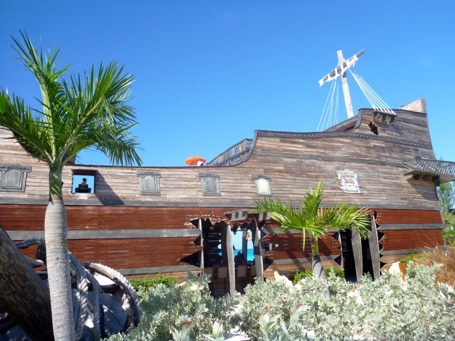
left: On the island close to where the passengers were dropped off, there is a wooden boat acting as shelter and as a café.
The weather was gorgeous, just round 77℉. The local tender could ferry some 200 passengers at a time from ship to shore and vv. The island seems to be sparsely inhabited, but at the terminal on the island you can book tours for snorkeling, go swimming with stingrays, go on a catamaran or do some windsurfing, etc. The beach just close to the disembarkation terminal was just as beautiful.
The kitchen staff from the ship took all the stuff along to provide us with an elaborate BBQ lunch with lots of fruits in a large hall. And in one of about a dozen small open-air pavilions we could have our lunch and enjoy the environment. It was a very relaxing and pleasant day. Next time we should take our swimming trunks along.
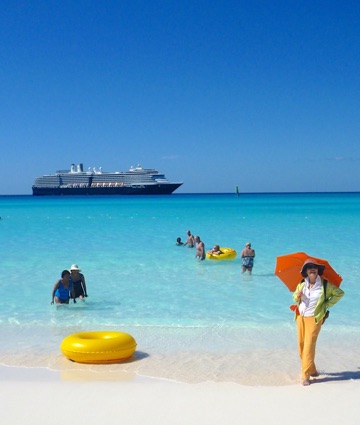
right: The Caribbean in a nutshell. Sun, turquoise water, swimming in the shallow beach, a lady with an orange umbrella, and the cruise ship in the background.
< II: Costa Maya, Belize, and Cozumel
Saturday, November 1, 2014