Easter Island

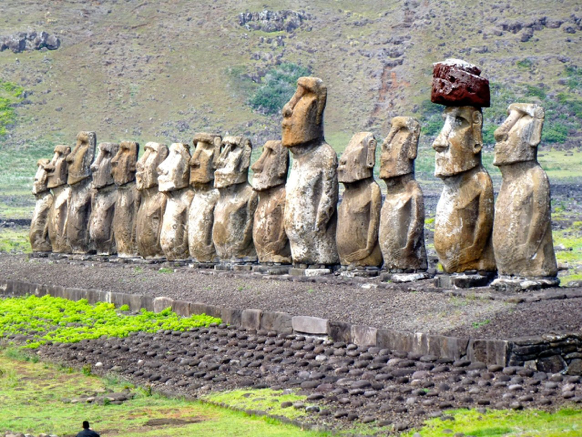

December 2 - 5, 2012.
You have to look at the map to see how isolated Easter Island is. There, in the middle of the Pacific Ocean, is this little speck, an island just about 8 miles wide and 15 miles long, well away from the rest of the world. It is presumably the most remote inhabited island in the world. But this islet is not well-known for its people, but rather for its huge stone statues, called moais., They had been created by the early inhabitants of the island and, as you can see from the picture above, they have been looking stoically straight ahead over the centuries.
The island is under the jurisdiction of Chile and goes by the official Spanish name of Isla de Pascua. The original name of the island was said to be “Te pito o te henua” which is often translated as “the Navel of the World”, to make it sound interesting. The Polynesian name is Rapa Nui, or Big Rapa, because of the topographical resemblance to Rapa in the Bass Islands. Rapa Nui now refers to the land, the people, and the language, and I will generally use Rapa Nui when I refer to this land.
The island is a UNESCO World Heritage Site and major parts of the land are now part of the Parque Nacional Rapa Nui. They are protected by strict rules.
The big wave of humans came here some 17 centuries ago, probably from the Marquesas Islands. They thrived and they constructed these huge monoliths, called Moais, presumably to protect them. They also had developed the Rongorongo script, the only written language in ancient Oceania. But as the population grew, this small island could not sustain the increase of human beings, which probably reached as many as 10,000 at one time. To survive they started to cut down the forests for fuel and to kill all the wildlife for food. The landscape became barren and the supply of food dwindled. If you see older coconut trees now, they have just been planted about two generations ago.
War broke out between different factions. They were competing for the resources, which were getting scarcer every day. Moais of opposing tribes were tumbled down. The wars did have the effect of reducing the population. Then, in the 1860‘s, Peruvian slave raiders devastated the local population by capturing about 1500 or 50 % of the population for slaves. When they were repatriated, the slavers intentionally introduced smallpox to further decimate the population. Then there was tuberculosis.
So, pretty soon, there were few indigenous people left and foreign interests started buying the land. For 45 years, in the early part of the 20st century, the land was used by the Williamson-Balfour company to raise sheep for their wool. At that time the few remaining locals became more or less outcasts in their own country. They were confined to Hanga Roa; many of them had to find shelter in caves because they could not afford a house with a roof. For heating they had to use dried dung, because there was no wood. The natives who worked for Williamson-Balfour were paid minimum wage, most of which they had to use to buy supplies at the company store at inflated prices. It is only recently that the indigenous people have recovered their often abrogated rights.
When Williamson-Balfour finally decided (or was forced) to involve more of the locals in its operations, Alvaro’s grandfather was appointed the major of the locals with whom Williamson-Balfour would communicate and work with. Finally, in 1953, after 45 years in power, Williamson-Balfour closed its operation and control of the island was transferred to the Chilean Navy. Only in 1966 was the island opened in its entirety to the indigenous population. Now who is Alvaro? He is the owner/operator of the guesthouse we stayed in and he was also our guide in the next few days.
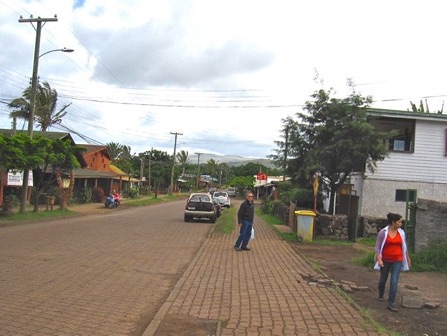
left: This is the main street of Hanga Roa, the largest community in Rapa Nui. It is still a rather sleepy neighborhood.
The country is still unspoiled in many ways. We did not see any high-rises to mar the landscape. I don’t know for how long. But it is said that Easter Island is becoming the destination of choice of the upstairs people of Romney Abbey.
There are two new hotels, the Hangaroa Eco Village and Spa, where daily rates start at $1,000, and the Explora Rapa Nui, where rates starts at around $1,600/night. And that doesn’t include the food. The Explora is a beautiful, luxurious, modern one-story building on a bluff. For that price, all the rooms have ocean views. You can’t say that of the Hangaroa. The Explora is in an enclave outside of town and I presume they want to stay in a class apart and try to avoid contact with the dirty unwashed masses.
For comparison, almost all of the other hotels and B&Bs in Rapa Nui are in the $120 - $200 /night range. Don’t confuse Explora with the Explorers Club. The latter offers a 5-day tour starting from Lima, 2 nights in Lima, 3 nights in Rapa Nui, flight Lima-Mataveri (Easter Island), and all the food for $1,800 only. That is a pretty good deal.
We happened to bump into a couple, who had friends staying at the Explora. So what do you get for $1600/night? “Well”, was the answer. “They have a special bus to take the guests on tours, and before the guests step in or out of the bus, the driver will put a footstool at the exit, so their lordships need only take a few small dainty steps out of the bus before landing on the ground.”. I have not been able to corroborate this; it could be just something tongue-in-cheek. But it would be just as apt.


Blog Summary Widget