Galápagos

The Galapagos Islands
December 5 - 18, 2012
.
I place the Galápagos Islands as one of the top 10 places you have to visit in your lifetime. This will probably raise the ire of the many conservationists who have been dedicating massive efforts trying to bring back the habitat of these islands to what it was before humans came and meddled with the environment. They have trouble enough with the many well-funded factions who would love to exploit the huge tourist potential of the islands and relegate the health and future of the wildlife to a much lower level of priority. They certainly don’t need me telling you to go there before you die, they probably much prefer you die first before you go there.
To their credit, the Ecuadorian Government and El Parque Nacional Galápagos have done an excellent job in establishing and enforcing rules for protecting the Islands and the environment by a.o., limiting the number of visitors, reviving species which are in danger of becoming extinct, and eradicating foreign species which have been introduced. True, they could do better, but things like this cost money, which is not always readily available. And the big money tourist industry is always ready to monetize and commercialize as much as possible. But now, however, this is the only place in the world where you can see and enjoy wildlife in peaceful and serene surroundings, and where you can see how evolution has more or less taken place without too much external influence.
And there you can appreciate the brilliance of Charles Darwin. He saw all this and he was able to develop the theory of evolution. It is actually incredible how he was able to put the pieces together from the evidence he had. To almost the rest of the universe, we enjoy seeing the wildlife, but we are all unable to fathom the presence of the key.
The Galapagos Islands are unique because they are so isolated. For centuries there were almost no new species coming in, thus allowing the local species to develop unhindered based on their environment only. 
left: A beautiful red crab and a marine iguana coexist peacefully on the lava beds. The iguana is doing his best to catch some sleep. The red crab is just walking over the iguana to where it wants to go.
The existing species coexist with each and go fearlessly around, because there are no predators for as long as they can remember.
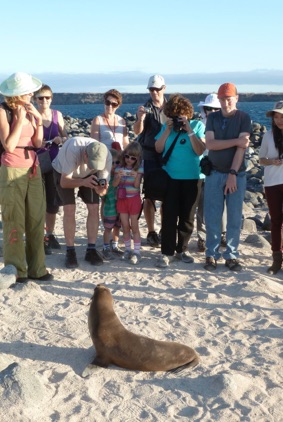
It is truly awesome to see the wildlife unafraid of humans moving along doing their daily chores, even be it just sleeping on a rock. And to the humans the first encounter is often utter amazement and joy, just as when you were welcoming your first child in the family.
right: Mazel Tov; it’s a boy.
I will not try to enumerate and describe the many programs which El Parque Nacional Galápagos is carrying out to keep this place unique. But of the many measures in place, I just want to mention their efforts to eradicate foreign introduced animal species in the archipelago. Over the last 200 years or so, visitors have come to the islands bringing with them, either on purpose and sometimes unwittingly, foreign flora and fauna, which have seriously impacted the existing natural environment. There is now a major project going on to remove some of the 700 foreign plants which have been introduced. But the removal of foreign fauna is more interesting.
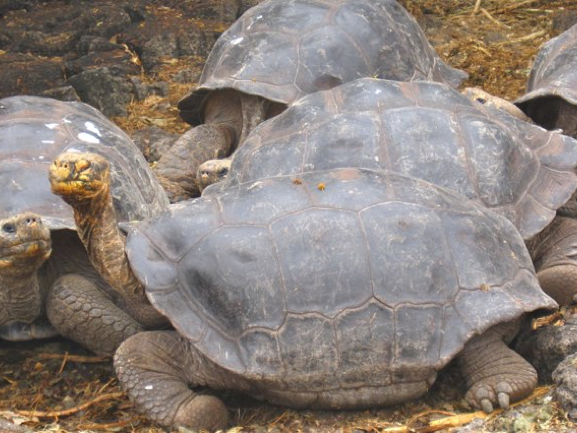
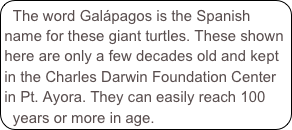
1: Goats came with the ships as a food source, but were then introduced into the islands to be bred for food. They give milk, and they are a good source of protein. Although not as prolific as the rabbit, they multiply easily. But the goats cause major problems, because they eat everything. Many civilizations in history have collapsed because goats have denuded the landscape as a result of their voracious and all-encompassing appetite. In the Galapagos, the goats eat most of the plants which form the staple food of the tortoises. The turtles cannot compete and will starve. In addition, by eating the vegetation to the roots, the goats also erode the soil.
Initially the program called for the goats to be killed by shooting as many of them as possible from a helicopter. The predictable reaction was a huge outcry from animal lover groups. They were invited to participate and to suggest a better solution to save the turtles. There were none. The shooting continued. The carcasses of the goats were burned, creating another outcry for wasted food. The slain goats were offered for free to anybody who wanted to pick them up. There were no takers. It is just too much effort to drag the carcasses from the bush. The goats were usually driven to a cliff, where they are an easy target for the sharpshooters in the helicopters.
But many goats still managed to hide and survive. To get at them a female goat was pumped full of sex hormones and then allowed to freely roam in the field, close to where the remaining goats were known to hide. Well, of course, hundreds of amorous males were attracted by her potent small of a female in heat. The sharpshooters mowed down the goats who had chosen to put the primeval call of sex above that of caution. For her protection the foil was painted white. Here is something we all should learn, but never will. There is danger in unprotected sex. By the way, this female goat was called Judas. I think Delilah would have been more appropriate. Some 400,000 goats were eliminated in this process.
2: Pigs also came with the ships as a food source. Some of them ended up on the islands and became feral. They dig up the nests of the turtles and devour the eggs. To go after these animals, hunting dogs were used to track them down for hunters to shoot and kill them. But feral pigs don’t go down easily and many a hunting dog lost his/her good life, gored by these pigs.
3: Rats come with the ships visiting the islands. They have a tendency to kill new-born turtles. To destroy them a major project involving the use of poisoned bait was instigated with good success.
4: Ants penetrate the nests and devour the newborn tortoises. They are exterminated using standard procedures.
5: Homo sapiens are known to be the most destructive species on this planet. History is replete with examples where they have annihilated whole civilizations. But they are now firmly embedded in the structure of the islands. There are currently no plans to eradicate this genus in the Galapagos.
Jeff Beachy, a fellow traveler we met in China in 2015, kindly offered to share his travelogue of his trip to the Galapagos. There are some amazing underwater pictures in his journal
https://drive.google.com/file/d/0BwuTfEAIOJkXOVcyZUR1U25RN2s/view?usp=sharing


Blog Summary Widget