Guilin and Minorities

 
     The last time we were in Guilin was in September 1984, more than 30 years ago. It is January 2016 as I write these notes. What I remembered were the karst mountains, very steep and most of them not more than a few hundred meters high, densely covered with vegetation. Well, these mountains are still there, as we expected. They are the main attractions of the area.


right: These are some of the karst mountains in the area. 

    As for the city, it has grown into a large town, as have every town in China in the last few decades. And as in most cities, it is a cityscape you see everywhere in China, bustling streets filled with lots of small shops, pedestrians walking all over the place, tall apartment buildings to house the burgeoning population, heavy traffic which looks very haphazard to the untrained eye.


   right: this is part of downtown Guilin. It still has the trappings of a small provincial town.


     This trip was part of a tour we purchased from Sinorama, the travel agency in Canada, whose specialty are their tours to China, which they have been able to offer at very reasonable rates because, I presume, they are partially subsidized by the local Chambers of Commerce of the towns we visit. It is all done low-key, and we did not have to purchase anything. But being on vacation, and after hearing all the glowing descriptions, most of us would buy something. 


a; The Guilin Tea Sciences Research Institute. 

    So the first destination was a visit to a “Government” sponsored plantation, unabashedly named the Guilin Tea Sciences Research Institute. Well, you can’t have anything more impressive-sounding than that if you are selling tea in Guilin to the unsuspecting foreign tourist. We were welcomed by the tea master who spoke flawless English, and who showed us the different tea varieties in their quite extensive tea plantation. He then invited us to attend a Chinese tea ceremony, where we would taste 5 different teas. We were seated on low stools around him as he prepared the different teas for us to savor.


right: The tea master getting ready to dazzle us with several different kind of teas. 

    The tea ceremony is highly ritualized, where the cups are preheated with hot water, and where the first drawings are discarded, before the tea is poured in small cups. Depending on the tea, the water temperature has to be within a fairly narrow range. 

    You savor the fragrant smell, and then you sip the tea. You close your eyes and imagine yourself to be in Nirvana. All this is to increase the appreciation of the tea you drink. And all this to make you more amenable to plunk down a lot of cash for their tea products (they take credit cards), presumably the very best in the world. We have been to other Chinese tea ceremonies before, but the only one which stood out in my memory was the one in Nanjang, because the tea mistress was one of the most beautiful young lady I have seen. She was a top graduate from the local Tea Ceremony Institute or something like that.


left: A beautiful young lady demonstrates the fine points of a tea ceremony in Nanjing. There are a number of venues there where you can partake, for an entrance fee, of the ceremony. 

    I have been drinking tea all my life and I must confess that what I usually do is to heat water in a kettle and after the water boils, pour it in the teapot where the tea leaves have been previously deposited. After the tea is steeped, the tea is poured in a cup and we drink the tea. If we need more tea, we just and  tea leaves in the teapot and pour in another batch of boiling water. We are obviously no connoisseurs, because the difference in the quality of the tea prepared our way or by the ritualistic tea ceremony is, by our plebeian standards, negligibly small.


     And yet, we never learn. After the tea ceremony we buy the most expensive teas and hope that we will be tasting the nectar of the gods in our messy home. Yes, this expensive tea tastes a little bit better, but not much. And if you don’t mention it, your guests will not even notice the difference between this elixir of the Heavens and the yellow-colored liquid from the common mass-produced tea bags from Ceylon. We are not the only ignoramus among all ignorami. 

    Still, it is good to know some characteristics of the tea culture. Good and expensive teas have a very short shelf life. To extend shelf life, keep your tea in a sealed container in a freezer. For other teas down the list, shelf life is not even mentioned. There is one exception; Pu Ehr tea which will actually improve with age. So, if you are in a Chinese restaurant, ask for Pu Ehr tea to impress them. 

    The most expensive tea is the white tea, where the tea is only made from the tips of the tea plant. You can imagine how much work it is to harvest just the tips from the tea bushes. The top grades are said to command thousands of dollars per pound, even though you can get white tea from Alibaba for as little as a few dollars per kg. 

    For green teas, you take the tip + 1 leaf or more. With one leaf, you get Grade 1 tea, with two leaves, you get grade 2 teas, and with 3 leaves, you have sunk to a Grade 3 tea. Below that the tea is so bad they are usually sold in teabags, so you don’t see what the composition is. Well, half of the stuff may be just twigs and older leaves; most people will not even notice. 

    Jasmine tea is ,of course, well know, where the jasmine flower is added to the tea. Also often used is the Osmanthus flower, which is not that well known except to tea afficionados. The osmanthus tree is quite common here.

    Then there is the pressed tea cake, made from several high quality teas, and very tightly compressed. These teas also improve with age and also command a premium price, which means they are exceptionally expensive when sold to gullible tourists. I bought a solid block of highly compressed tea, 250 gr in weight, 5 year old, for around $70. You need a hammer and chisel to break off a piece, but the tea is indeed very good. 


b: The Guilin South Pearl Museum.

    This place was next on our to-be-hit list. It was called a museum to create the impression of a venue, superior than a regular store. They do have a few interesting items on display, but their main purpose is to sell you their pearls. They tell you that their museum (I mean store) is so special that President BIll Clinton one time visited them and purchased a pearl necklace for Hillary. I have not been able to check the veracity of this claim. Most of their pearls come from the South China Sea, which is quite a distance away from Guilin. They use this fact to tell you that because of this, they only take the best pearls from the source, and take only very little profit because not many potential buyers come here. 

    But their presentation is first-class. After walking through the “museum”, they will take you to a theater hall, where beautiful young ladies walk down a runway to give you a show of the products they carry.    https://www.youtube.com/watch?v=2VUSFog_1ZA


   right: This is part of the showrooms for their products. The picture also shows Jeremy and Bonnie, from Baja, Mexico, members of our tour group.


    There is an adjacent showroom, where they only show very expensive pearls and arrangements. After going through that section you are conditioned to believe that all the products in this part of the showroom are inexpensive and a good buy.  


https://www.youtube.com/watch?v=2VUSFog_1ZAshapeimage_2_link_0
Subscribe to RSS Feed
 
Blog Summary Widget
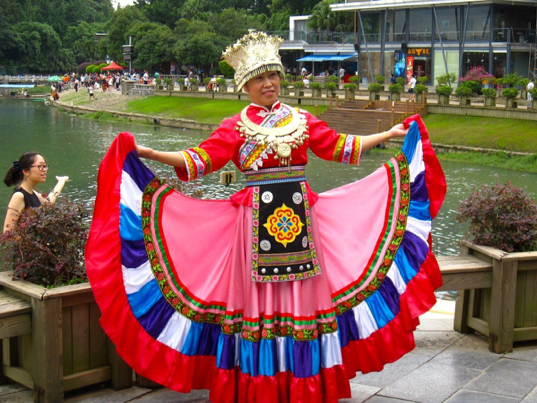
A member of the Dung Minority in her festive clothing.