An Occasional Tourist in Japan
2009

Travel journal: April 7 - 23, 2009
You come home from a trip and your friends ask you: “How was it?”. This is, of course, a rhetorical question. It is a waste of time to give a considered and incisive essay, because they really donʼt want to hear it. They only use this opening so they can tell you about their trips. So you generalize.
Yes, it was good trip. Yes, we enjoyed it. We saw and experienced a lot. Japan is clean. The streets are free of trash. So are the subways, the gutters, the parks, the public places and almost everywhere else. I thought Argentina was clean. But Japan is cleaner, even though there are fewer trash-cans around and there are almost no signs to warn you to keep the environment free of garbage. People take their trash with them. Most probably in a plastic-lined specially assigned pocket in their pants. Public bathrooms are spotless and you can step to the receptacles without having to wade through an arm of the Great Lakes. The kids are trained from early age to aim straight and true.
Japanese walk around with surgical face masks to keep dust and germs away. You can do so too without feeling out of place. It is useful if you need to rob a bank or have an assignation d’amour with a sultry beauty. With the swine flu scare going around, more people will be wearing these masks. On hot days the air in public transportation is quite free of offensive odors. If you do encounter some, there is probable a European tourist lurking somewhere. Americans, for the most part, have the sense to use something to mask the problem.
Japan is neat and tidy. Everything has its place. Cars are all parked by backing into their parking space, which takes more effort than just driving in. It is indicative of their mentality. High school kids wear neat-looking uniforms. In their houses, they pack their stuff away from sight, so the effect is minimalist and neat. It is hard to find any weeds sprouting away in unabashed glory, unless you go to the cheaper areas in the outskirts of the large cities. 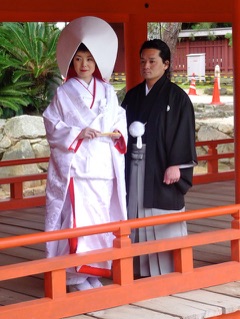
Japan is formal. Men still wear dark suits everywhere, even when the weather turns warmer. The last time I saw almost everybody wearing dark suits was some 50 years ago in the financial district in London. Women are nicely dressed, some of them in beautiful kimonos. If you see men wearing casual shirts and jeans, they are probable tourists. If they look like slobs, then they are definitely tourists.
right: Of course you dress formally on your wedding day
Japanese are polite. One day we were the first customers in a department store and the members of the sales staff were lined up next to their sales area bowing to us as we walked by. In the trains, you will see the door to the next wagon open and the conductor come in. He will first bow to the people in the car before walking through the train checking our tickets. And as he leaves the compartment, he will turn around, and bow again before stepping out through the door. The attendants pushing the food carts though the train do the same thing.
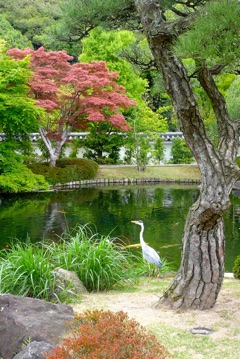
Japan is very photogenic. I have taken about twice as many pictures per day as I have in other places in my travels. This is especially true about their gardens, their flowers, and their architecture. Every self-respecting Japanese has a garden, which they tend with loving care. There are gardens everywhere, next to the houses, inside the houses, inside small spaces in restaurants. And flowers are surprisingly inexpensive.
left: In the Koko-en Gardens in Himeji. The egret is actually an unwelcome visitor because it eats the fish in the ponds.
Japan looks prosperous. The houses are all well-tended and in good shape. There are many large classical Japanese houses around. Everybody seems to have money to spend in the restaurants, where food is about twice as expensive as in the USA. There are no beggars or panhandlers around. No shopkeeper is going to waylay you, as you walk down the street, to insist you look at his shop and his stuff, specially priced down for you today. Nobody in Japan seems to realize that their national debt is 194 % of their Gross Domestic Product.
Compare that to the USA, where our national debt is “only” around 72.5 % of our GDP. (these are 2008 numbers; I think it is close to 100% now). Our houses donʼt even look that well taken care off, and in the mornings you will stumble over sleeping homeless people, beggars, and panhandlers in most major cities in America.
Japan also has a lot of older people. More than 20 % of the population are seniors, over 65, and the trend is growing. For comparative purposes, the United Nations standard for an “Aging Country” is 7 % above 65. Every time we buy a ticket to enter a museum or some event, Andrew always asks whether there is a senior discount. There is none in Japan; they would lose too much money. Half of Japanese tourists are probably over 65. 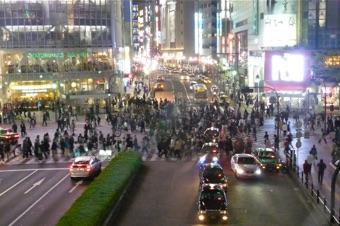
left: the Shibuya Ekimae Kosaten intersection in Tokyo at 10 p.m. Some 750,000 people cross this intersection each day.
Japan is crowded, especially in Tokyo. By area, Japan is the 61st largest country in the world. But by population, it is the 10th largest country. No wonder they are packed in. In Tokyo, 13 million people, or about 10 % of the Japanese population, are crammed in 850 sq miles, or 0.6 % of the total area of Japan. To get around there are elevated freeways criss-crossing each other all over town. It looks like the prototype of a city in a sci-fi movie. There are trains on elevated tracks above ground and trains under the ground. At the Shibuya Ekimae Kosaten intersection, which divides the Shibuya railroad station and the entertainment district, an average of 750,000 people cross this intersection every day. The picture shows the intersection at 10 p.m. With so many people packed together, houses tend to be small and crowded. If you want privacy, go to the Love Hotels for a temporary place for privacy and trysts.
Not only is Tokyo crowded; so are all the tourist sites in Japan. And 90 - 95 % of the tourists are Japanese, many of them schoolchildren on field-trips. It is decidedly different to read in a travel book about a famous Zen Buddhist formal rock garden created for meditation and introspective thought and getting there in person by jostling through a few hundred other tourists, all bent on taking pictures of the garden without too many other people on it. Well, at leas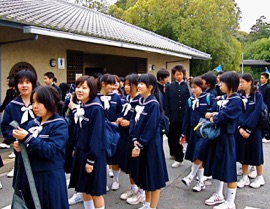 t they were all well-behaved and they don’t smell.
right: Schoolgirls as tourists.
And with all those people around, it is easy to miss the essential part of the tour.

Blog Summary Widget