

II: Greek Ports of Call
a: Visiting Santorini (Σαντορινη)
This is arguably one of the most beautiful islands in the Aegean Sea. At one time it was even known as Kalliste (Καλλιση). which translates to “The most beautiful one”. The official name of the island is Thera (Θηρα). It is one of the most southernmost islands of the Cycladic Islands.
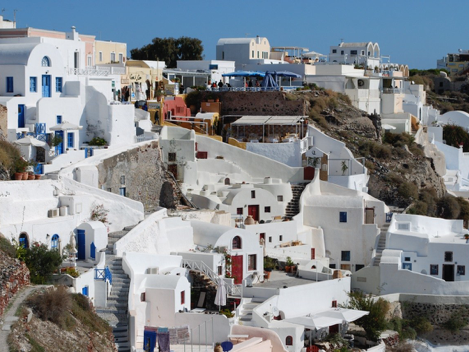
We had spent a few days visiting in Santorini a couple of years ago, but the scenery remains as breath-taking as it was before. As your cruise ship sails into the lagoon, which is actually a caldera, you see the white houses way up high on the rim of this volcano, which blew out around 1450 BC. This explosion created this shimmering rectangular lagoon, about 7.5 by 4.3 miles. The cliffs are red, steep, and high, jutting out some 300 meters above the water.
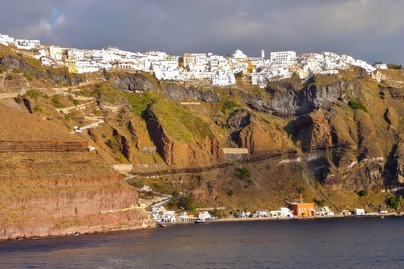
left: View of Santorini from the water. The funicular is behind the rock wall on the left
There is still some mild volcanic activity in the area which has built two small islands within the caldera. The climate is dry and there is always sunshine, which makes for the perfect setting for marvelous photography. In addition, the local authorities impose strict architectural building codes on the island to maintain uniformity and harmony. It is the combination of these white houses, red cliffs, and the blue lagoon, that makes the setting so spectacular.
We were tendered in to the base of Fira, the largest town on the island. From there we had a choice of taking a donkey to go the 1000’ up the zig-zag trail to the town, walk and avoid the trail of donkey poo, or take the funicular. We opted for the latter, even though there was a long waiting line for the cable car. The fare was €6 one way.
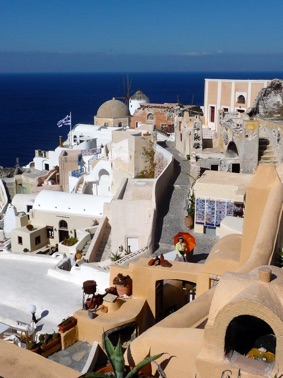
right: Another view of Oia
As you would expect, Fira is your complete tourist town. Every building is a tourist shop, a bar/café/restaurant, or a hostel. Because of time constraints, we headed straight to the bus station to take the bus to Oia, which is the next-largest town on the island, and deemed to be the prettier of the two. Another reason is that the light in Oia is better in the morning, and in Fira the light is better in the afternoon.
One problem of traveling with a cruise ship is these ships disgorge hundreds and sometimes thousands of passengers in a short period of time So you a have a waiting line everywhere you go. In addition, you lose a lot of time to get ashore because of the limited tender capacity.
Once you are at your destination, you have to watch the time to get back, because it would not do to miss dinner and/or the ship. This is where staying on the island makes the big difference, because there is much less pressure, and you can amble around at your own snail’s pace.
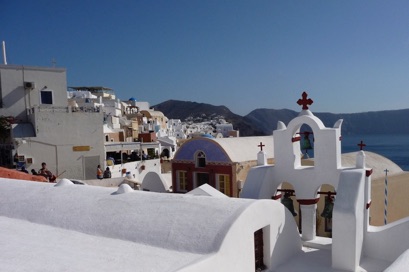
left: A church in Oia.
The buses from Fira to Oia travel about every hour and a half, with fewer buses on the weekends. Consult the timetables. The fare is €1.60 one way and the buses are always full, with lots and lots of people standing in the aisles. I don’t even know whether they have a limit on the passengers they carry. One of these days I expect to see passengers stacked on top of each other in the bus like in those large shipping containers. There is also no organized queue to get into the buses. It is OK from Fira, which is where they start, but in Oia, you will only get a standing space if you don’t wait on the exactly right boarding place, when the bus stops.
Another good option is to rent a small car with manual transmission, which will cost you €25-30 + €7-10 insurance. You can then drive around the island and even stop at Selene for lunch or dinner. The food there is superb haute cuisine. Five years ago the two of us were there and shared two appetizers, one main dish and one dessert. With the wine, coffee, and tip our bill was €95, which was quite reasonable for what we enjoyed. You could also have come there for lunch with the tour organized by the ship, which will set you back $355/per person. It’s just money; nothing serious. You do not get a silver doggie bag to take the excess food home.
Like everybody else, we ambled through the tourist-shop flanked main pedestrian path through the city of Oia to almost the end. Then we stopped in a café for a cold beer and to make use of the bathroom, and we looked at the castle ruins below, where the last time we stood watching the sunset. But there was no time now. Like everybody else, we took lots of pictures. We went back to the bus station to go back to Fira.
The line for the funicular in Fira going down was very long, so Larry and Millie opted to just walk down, after being warned to watch out for the many piles of droppings from the donkeys on the road. By the time we got to the funicular and down, they were almost there too. We sniffed whether they had taken some souvenirs along. But no; they had missed all those piles of dung.
We were back in our ship shortly after, the sheltered cocoon, a world apart, having our usual extensive dinner in the dining room.
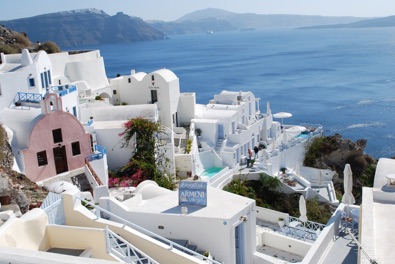
right: a view of Fira
There are almost no public bathrooms in the Greek ports of call described here, so older people fear of possibly running into serious problems.
But you can go to any café or restaurant to use their restroom. The local laws apparently require them to be available for tourists without having them to purchase anything.
b: Visiting Rhodes (Ροδος)
Rhodes, the largest of the Dodecanese Islands, was famous even in antiquity because of the Colossus of Rhodes, one of the Seven Wonders of the Ancient World.
The history of Rhodes goes way back. The Minoans came to Rhodes in the 16th century BC. A few centuries later the island was occupied by the Persians, then by the Greeks from Athens. Then it became part of the empire of Alexander the Great. In 305 BC, Demetrius, son of Antigonus, besieged Rhodes with huge siege engines, including an 180 ft battering ram and a siege tower weighing 360,000 pounds. The first siege tower was mounted on 6 ships. It capsized in a storm. The second was land based, but the defenders in Rhodes flooded the plain. The structure bogged down. Then Ptolemy arrived with a couple of warships to relieve the city. So Demetrius had to abandon the siege, leaving behind a huge supply of military equipment. The defenders of Rhodes sold this windfall and used the funds to build the Colossus, a statue of the sun god, Helios.
The giant bronze statue was built straddling the entrance of the harbor and was completed in 280 BC. It was 107 feet high, but it was unfortunately destroyed in a major earthquake in 224 BC. The remains laid on the ground for 800 years before it was sold to a merchant in Edessa. He needed 900 camels to transport the bronze scrap to his home.
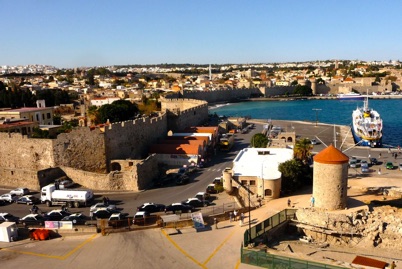
left: View of Rhodes from cruise ship. You can see the walls of the Old City.
The Romans came, then the Muslim forces overran the place is 672. It was recaptured and became part of the Byzantine empire. Then it fell to Suleiman the Magnficent, and for four centuries it was part of the Ottoman empire. Then Italy seized control; but in 1947, the island was reunited with Greece.
With its rich history, visiting Rhodes is very interesting. The island has many attractive historical sites. I will cover only two; the Acropolis of Lindos and Rhodes Old Town.
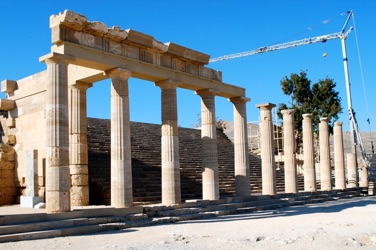
right: Part of the restored acropolis and theater in Lindos
Even if you have only one day available, it is still possible to do both reasonably well. In the early morning take a taxi from the cruise terminal to Lindos to view the Acropolis and a bit of the town before going back. Taxi fare was €110 for the round trip. We failed to do this, but our friends Larry and Millie did this. This can be done in 4-5 hours. Then go to the Walled Old Town of Rhodes.
There are three harbors adjacent to each other on the north-east part of the island. From west to east; the small and ancient Mandraki harbor, with the entrance where the Colossus used to stand; the large commercial harbor, and the New Port harbor. The cruise ships usually are moored at the narrow pier separating the two latter harbors. As you disembark the ship, there is an entrance of the Old Walled city nearby, which is usually the Mylon Gate.
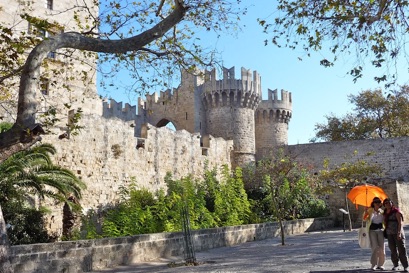
left: Norma and Millie at the Palace of the Knights of St. John in Rhodes Old Town
The medieval Old Town of the City of Rhodes is now a World Heritage Site; it is also apparently one of the most popular destinations in Europe. The economy of Rhodes is strongly dependent on tourism, so it is not unexpected to find tourist shops everywhere.
There are many interesting things to see, thousands years of history packed in this compressed area of the Medieval Old City. Do go to the Archeological Museum first, because they close at 3:00 p.m, the last visitor allowed inside is at 2:40 p.m. Also go to the Palace of the Knights of St. John, also known as the Palace of the Grand Master. They also close early. You can leave the shopping until the last, because the tourist shoppes will stay open as long as there are still cruise ship passengers sauntering around. And what you miss here, you’ll find at the next port of call.
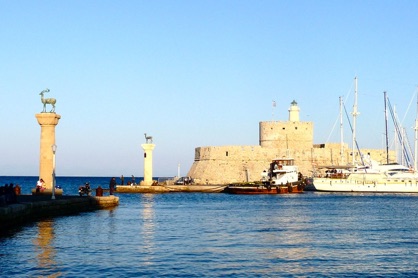
right: Entrance to Mandraki Harbor.
At the end of the day, we walked out of the city, past the ruins of the Temple of Aphrodite, to the entrance of Mandraki Harbor. Two bronze deer statues mark the spot where the feet of the Colossus once stood.
Looking on the Greek Dodekanissa web, I found that the top 5 activities to do on Rhodes Island were listed as (a) sunbathing, (b) swimming, (c) snorkeling, (d) diving, and (e) surfing. I guess we missed all of them. Or, we were just in the wrong age category.
c: Kos (Κως)
On our flight back home, the lady next to us lived in New Jersey. Her parents, in their early sixties and of Greek descent, had gone back from the States to retire in Kos. So, Kos must be attractive and the weather must be good. Although, coming from New Jersey, it doesn’t take much to find a place with these requirements. Kos also does not have the Jersey Boys, and that may be another reason to flee to Kos.
If you are in Kos for the first time, you have to view the Asklepeion. An Asklepeion is a healing temple, sacred to the god Asclepius, the great healer. The famous Greek physician Hippocratus is said to have received his medical training at the Asklepeion in Kos. The Asklepeion is situated 4 km southeast of Kos, From the cruise ship the best way to get there is with the blue tourist mini-elephant train. After you disembark walk along the shore with the water on your left and the castle walls on the right until you get to the bus stop, around where the castle walls end. This is where the blue train starts..
This train leaves every hour on the hour, with the first train leaving at 10:00 a.m. so you can feel being a tourist even before you reach your destination. But this tourist contraption does not run every day, especially during the low season.
In that case you have to go with plan B, which is to take bus no. 3. The bus stop, where you were forlornly looking for the non-existent tourist train is also the beginning of the run of Bus 3, so the bus may wait here for a few more minutes. This bus will take you to about ½ mile from the Asklepeion. From this bus stop to the Asklepeion is about a 10-minute walk.
Be sure to ask the bus driver when he will be back, usually about 1 ½ hours later, which is enough time to walk to your destination, view the place, and walk back. This is also the least expensive way to get there, I think it is around 1.5 euro per person one way. If the bus is empty, the bus driver will make the detour and drop you off at the entrance of the site and then pick you up there again. Just give him a nice tip in that case. If you take the bus, you can also ask the driver to drop you off in the middle of the town close to the ruins of the Ancient Agora on the way back to have a look.
The Asklepeion in Kos dates from the first half of the 3rd century BC. There are three terraces. The lower terrace hold the ruins of presumably the medical school itself. There are remains of Roman baths, as well as porticoes of buildings for the patients and families.
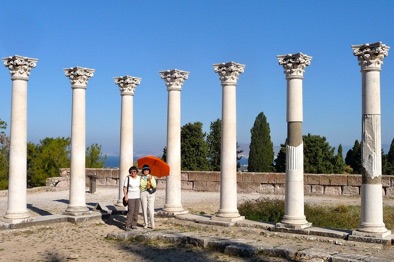
left: Norma and Millie at the Temple of Apollo on the middle level of the Asklepeion
On the middle terrace are the oldest structures, with the ruins of an altar from the 4th century BC. There are some restored columns from the 2nd century BC Ionic Temple of Apollo, shown on the left.
On the top terrace are the minimal remains of the Doric temple of Asklepeion, dating from the 2nd century BC. There is a forest around the site, and from this location there is an excellent view of the town of Kos and the surrounding suburbs, with the port and the Aegean Sea in the distance. We can well imagine that the serene surroundings and the beautiful may have been beneficial for the patients. The basic tenets in those days for healing were good, clean water, plenty of fresh air, and a pleasing environment.
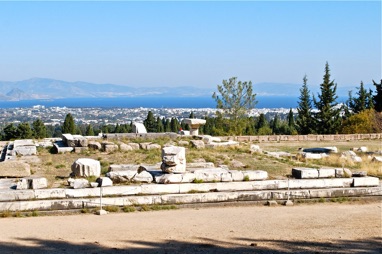
right: the top terrace of the Asklepion in Kos
Many posts in TripAdvisor will tell you that it is a steep and tiring climb to get to the third level of the Asklepion. It is indeed a steep staircase, but nothing compared to the stairs on the Mayan pyramids. I am 79 years old and I easily climbed this staircase in less than 2 minutes. You can really do the whole site on your own in less than an hour, or if you wish to spend more time, you can listen to tour guides spin long colorful stories, which may or may not be true.
If you take the bus back, there is a stop in the middle of the town close to the Ancient Agora. You can amble through the ruins before getting back to the ship.
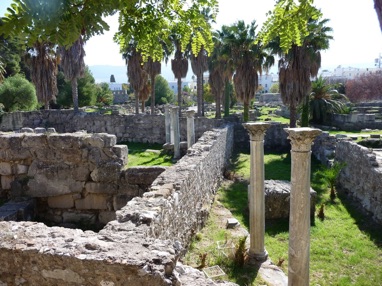
left: View of the Ancient Agora
After taking the bus back to the starting point close to the castle walls, it is a short walk to the Tree of Hippocrates, an ancient plane tree where, according to legend, under its shade Hippocrates discoursed on the fine points of medicine with his chosen students.
The tree is not only old; it looks old. But not that old. Maybe 600 years old. It could be a descendant of the original tree, which allegedly stood here 2400 years ago. Metal structures give support to the creaky and hollow limbs; it is a sad-looking tree.
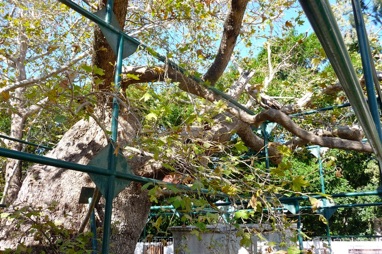
right: The tree of Hippocrates. To the left at the bottom of the picture is the big, now mostly hollow, main trunk. Younger branches sprout out from this trunk.
From there is a short walk over a small bridge into Nerutzia Castle, also known as the Castle of the Knights of St. John. Well, there is not much left of the castle, and the only operating building we saw was to house the public toilets. But you can walk around the castle grounds and on the solid ramparts of this fort.
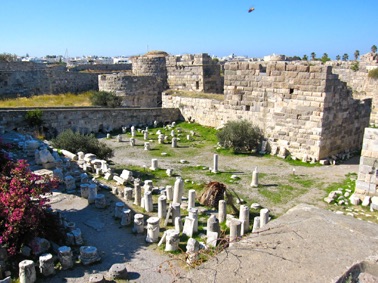
left: Them main inner courtyard of Nerutzia Castle is used for storage of miscellaneous fragments from the original castle.
What is especially interesting and useful is that there is free internet in the open air on shore close to the cruise ship terminal. So you can take your laptop or ITouch or whatever, sit in the shade, and do your communication with the outside world, substantially cheaper than using the ship’s internet system.
Our ship was actually delayed at departure for a few minutes because of a missing crew member. He was on shore surfing the internet and forgot the time. Those must have been some very interesting websites he was looking at. He is not going to do this again, if he wants to keep his job.