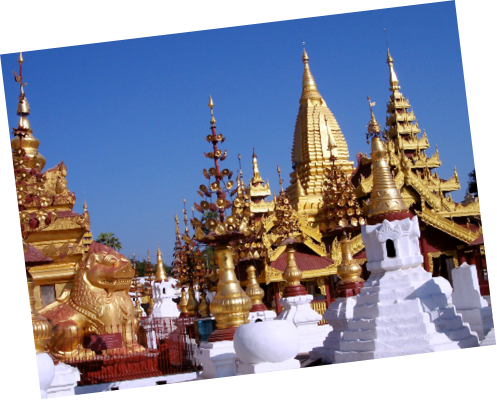
Myanmar; Travel journal: Jan. 16 - 26, 2007
Welcome; Min-galaba.
Blessing be on you, “Min-galaba”. This is the standard greeting in Myanmar, the country erstwhile known as Burma. You do not have to make adjustments for morning, afternoon, evening, political inclination, social status, or whether you are male, female, transvestite, or hermaphrodite. Just say ‘min-galaba’ and smile. The faces of the people you address will immediately light up as they graciously reply ‘min-galaba’ to you.
Buddhism in Myanmar
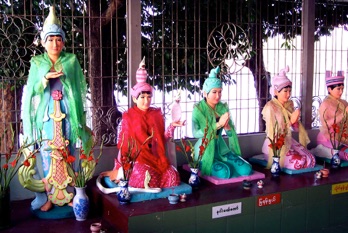
The culture of Myanmar is synonymous to Buddhism. Buddhism, predominantly of the Theravada tradition or the southern school, is practiced in Myanmar by about 90% of the population. This is the oldest, most orthodox and the more conservative branch of Buddhism that adheres to the Pali canon as the authoritative scripture and which strives for the ideal of self-purification as the road to Nirvana. Surprisingly, the population also believe in “Nats”, spirits which predate the arrival of Buddha. There are 37 Nats and many temples have sections where these Nats are revered.
So, most of the Burmese festivals are related to Buddhism. During the Burmese New Year, Thingyan, also known as the “water festival” many Burmese boys celebrate shinbyu, a time when the boy, after he passes his 7th birthday, can now enter the monastery for a short time as a novice monk. Usually the parents wait until he is at least 10. His hair is shorn and he has to stay in the monastery for at least two weeks, usually longer, to study the teaching of Buddha. There are some 500,000 monks in Myanmar.
The picture above shows young monks waiting to be invited for food. The donor is setting up the food to the left.
Every male is expected to take up temporary monastic residence twice in his life; once between the ages 10 and 20, and once after 20. As a monk, he is dependent on a giver for his daily food. They are fed only once a day; in the late morning . The giver earns merit by offering food to the monks. So in the mornings you will see many monks walking on the streets with their rice bowl in their hands, waiting for somebody to call them and offer them food.
Tourism in Myanmar
Tourism is still a relatively small item in Myanmar’s economic picture. In 2003 roughly 70 times as many foreign tourists visited the fleshpots, shopping, food, beaches, and other pleasures of neighboring Thailand compared to the more staid attractions of Myanmar. In that year income from the export of gas alone from Myanmar was more than five times their income from tourism. The repressive regime does not make it easy to visit the country and does not really encourage visitors to come.

Unless you come with money to gamble in the casinos, entrance to which is restricted to foreigners only. Income from gambling is huge, estimated to run into billions of dollars, because gambling is prohibited in most of the surrounding countries.
The Myanmar regime gets a cut of everything and makes money from the sales of gas, teak hardwoods, gems and lots of other stuff; for them income from tourism is actually quite small. The regime keeps a tight lid on the pro-democracy movement, especially the one under the leadership of Aung San Suu Kyi, called respectfully, or disdainfully, depending on the political persuasion, as “the lady”.
To make an international call, you have to go through a state-sponsored company who charges you around US$10/minute for a call to the USA. Yahoo is blocked in Myanmar, and since my e-mail address is @yahoo.com, I had to go to another site to access my mail through the “back door”. This was excruciatingly slow and I basically gave up for the duration of the trip. It didn’t make much difference. Nothing earth-shaking happened when we were gone. Bush was still stubbornly pushing his private war in Iraq, and the stock market had not collapsed.
Abbreviated political history.
Of the recent history of Burma, the name of General Ne Win regularly crops up. He was voluntarily handed power in 1958 by U Nu, the prime minister, when the economy and the political conditions of the country were spiraling precipitously downwards. He managed to restore some law and order and handed back power to U Nu 15 months later. But political turmoil erupted again and General Ne Win took over again, this time with force, abolished parliament, and threw U Nu and his main ministers in prison. In 1981 Ne Win retired as president of the republic. He did retain the chairmanship of Burma’s only legal political party at that time. In 1988, after things became worse, Ne Win voluntarily retired from that post too and withdrew from public life.
But his influence on the political scene remained and his successors appeared to follow behind-the-scenes orders from this reclusive dictator. There were massive pro-democracy demonstrations on August 8,1988, which were brutally crushed by the Government. Some 3000 people were killed. In May 1990, the government allowed free elections, the first in 30 years. Even with the many restrictions, the National League for Democracy Party (NLD) of Aung San Suu Kyi won 392 of the 485 contested seats. But the Government barred the electorate from assuming power and many key members of the NLD have since been imprisoned and killed. General Ne Win died in 2002. People in Burma are circumspect in their expressions on the political situation, and there seems to be ambiguity on how to view Ne Win’s role in Burmese history.
In the same year, prime minister Khin Nyunt, another disciple of Ne Win, introduced the seven-step “Roadway to Democracy” program. But he was ousted in the October 2004 coup by the hard-liner Than Shwe, the current man in power, who arrested the prime minister and his whole family and “permitted” him to ‘retire for health reasons’. He also went so far as to erase the name of Khin Nyunt from many public areas in pagodas, where his name had been inscribed as a benefactor of that particular religious shrine. You don’t want to have the population associate the guy you just deposed with religious piety and protection by the heavenly hosts. The political situation is a mess. The lady Ang San Suu Kyi is still under house arrest. Most of the world condemns but China firmly approves the current Government of Myanmar.
As for the recent turmoils, check the many publications and reports.
But we did not visit Myanmar for its history and politics; we were there because it is such a visually enchanting country. And as more tourists enter the country, the contacts generated may hopefully give the population a better chance to be an active part of the mainstream world.