






Paradors in Spain - I
Travel journal: April 17 - May 1, 2005
The Paradors in Spain 

    Parador means 'stopping place'. In 1910, the Royal Tourist Commissioner in Spain spearheaded the creation of these paradors in places of special interest or in remote locations. Originally they were to provide inexpensive accommodation to travelers in areas that would not normally be profitable.  The first parador was established in the Gredos Mountains, and subsequent ones were set up at distances that were considered a day's travel apart. The other rationale was that this approach would make good use of all the run-down monuments and historic buildings that would otherwise be left alone to fall apart. But over the years, the emphasis had changed. The “Paradores” of Spain, the result of his proposal, comprise now of a chain of quality lodging places all over Spain, but still operated under the auspices of the Ministry of Tourism.

    Paradors are now found in modern, attractive buildings as well as in ancient and historic places such as castles, palaces, convents and monasteries. They are located all the way from Galicia in the Northwest through Catalunya to Andalusia in the south of Spain, to the Canary Islands and the Spanish cities in North Africa. Each parador is a hotel with modern facilities. They are usually rated as 3 or 4 star hotels, with a few commanding a 5-star rating.  Currently there are nearly 100 establishments in the parador chain. Almost every parador has its own unique story to tell.

    Because the paradors are set up by the state, they can be established in historical buildings or other venues not normally accessible to individuals, large travel companies, or hotel chains. In addition to their unusual, and sometimes spectacular locations, the paradors offer the regional cuisine in their very good restaurants. And even though they are part of a chain, each parador is a separate profit center and they do compete against each other to offer the best they can from their region. They certainly do not strive for conformity. And each parador is proud of what their restaurant offers. 
  
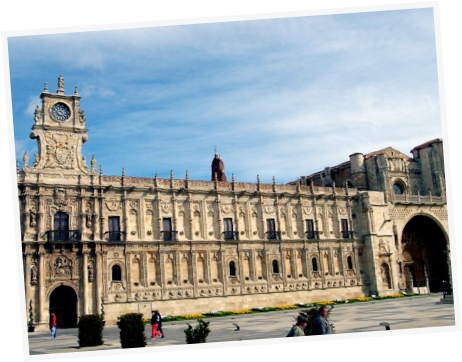
left: And this is the left side of the façade of the Parador San Marcos de Leòn. The parador itself only occupies a part of this structure.

   Even though most paradors are fairly expensive, the demand for rooms is still great, so many need to be booked up well in advance. For the more popular places and/or during the holiday season in July and August booking as early as one year in advance may be required. These are exceptions. Most of the paradors do have rooms available outside these constraints. And to boost traffic during the slower periods, the paradors do have special promotions, such as a 5 night-card, allowing one to stay 5 nights in different participating paradors, etc. The one we used most frequently is the “Golden Days” promotion, available for guests older than 55 years. These promotions can be used at selected participating paradors, and usually only during mid-week and in the low and middle tourist season. For the Golden Oldies the discount is 35% on the room rate and breakfast is thrown in for free; otherwise you have to pay extra for the really good breakfasts. There is joy in being well aged by time and being able to visit these paradors at these discounted prices. Another advantage is that the paradors are usually not fully booked during these times.

    To obtain a good overview of the paradors, click here. You will see a map of Spain with information on the individual Paradors by clicking on the red dots on the map.

    This journal describes the 6 paradors we visited in the spring of 2005.   I am also including a description of some of the other interesting places we visited on our journey.

http://www.spainparador.com/shapeimage_3_link_0
Subscribe to RSS Feed
 
Blog Summary Widget
The right half of the impressive façade of the Parador San Marcos de León.