Small Ship Cruising on the Adriatic

III: Trstnik and Viniculture
links:
On a Slow Boat on the Adriatic
Paris, 1976. Before an international panel of established sommeliers and VIPs in Paris, there was a blind tasting of France’s fabled white Burgundies and the upstart Chardonnays from the Napa Valley. Surprisingly, the winner was not a French wine, as expected, but the 1973 Montelena Chardonnay produced by the Grgič winery in Rutherford (in the Napa Valley), California. That established the Napa Valley as a high-quality wine-producing region and the Grgič winery as a premier establishment for superior wines. In the intervening years the Napa Valley region and the adjacent Sonoma Valley have exploded in capacity and now you will be driving miles after miles past vineyards, many of them less than 10 years old. There is a glut of California wines on the market and you can now get good table wines for less than US$ 10/bottle. But the upper echelon wines remain expensive, giving solace to the well-heeled connoisseurs, who wish to retain their lofty cachet, far away from the madding crowd.
But the more important item here in Croatia is that Miljenko (Mike) Grgič is Croatian, and just recently has gone back to his homeland to established a winery, under the supervision of his daughter. His winery is in the hills of the Pelješac peninsula. In Croatia, when the conversation turns to wine, the Grgič name always pops up. Which may be a bit unfair, because viniculture has been here for centuries, and the locals already know how to make superb wines. Supply is limited and Croatian wines are not that well-known outside the country. So now you see everywhere patches of land being cleared for viniculture to cash in on the expected surge in demand.
We dropped anchor at the port of Trstnik, (Croatians are very frugal with their vowels) charmingly nestled in a small cove in the middle of the Pelješac Peninsula. It is a small town, but the island itself is an important center of the production of high-quality red wines. There are some 7 wineries on this island, and the Grgič winery is one of them, actually just about 2 km from where our ships are moored.
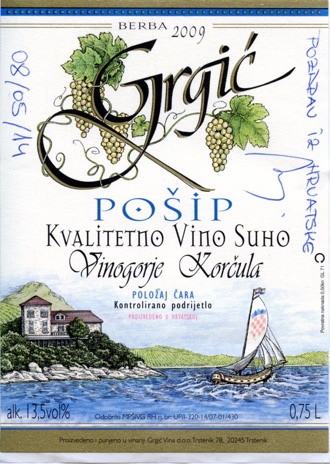
Everybody traipsed up to the winery where one can taste a red and a white for a tasting fee of Kuna 30, which translates to about US$5. That was rather steep, we thought, but if you have the name, you may as well cash up on it. The wines were good, but certainly not exceptional. And after all that hype, it was rather disappointing. I suppose those were not his best wines.
left: A 2009 Grgič Pošip label, hospitably signed by a staff member of the Grgič tasting room.
For comparison, the Grgič winery in the Napa Valley charges US$30 for a flight of five wine pours of 1-oz each of Mike’s Selection, or US$20 for the 5 1-ounce pours of the current release Napa Valley wines, so the Kuna 60 for one red and one white was not exorbitant. It may be on the high side for the local wineries on the island.
A few hundred yards up the road was a small cemetery with a small memorial chapel. From the small courtyard of his this building one can enjoy the a sweeping view of the bay. This little chapel is actually lit up at night and can be seen from our ship, maybe 2-3 km away, high up on the hillside.
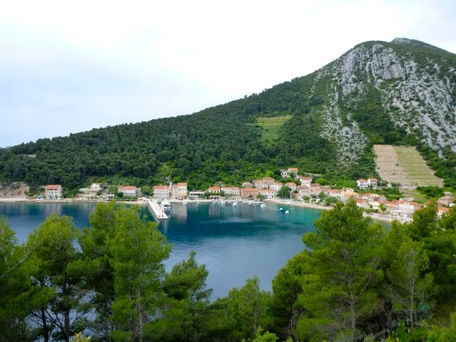
right: In the distance is the little village of Trstnik and the adjacent Bay. Our ship is in the middle of the picture. On the right, at the lower half of the hill, you van see a large patch of newly prepared land for a new vineyard.
As we returned from our walk to Grgič winery a man came by and offered a tour and visit to three other wineries in his van for the afternoon for €10/person. His name is Ante Primorač of Noranda Tours, noranda.tours(at)gmail.com. There were actually some 14 of us who accepted his offer, so he had his wife came by with her station wagon. This proved to be a great deal, because the tour also included the tasting fees in the three wineries we visited.
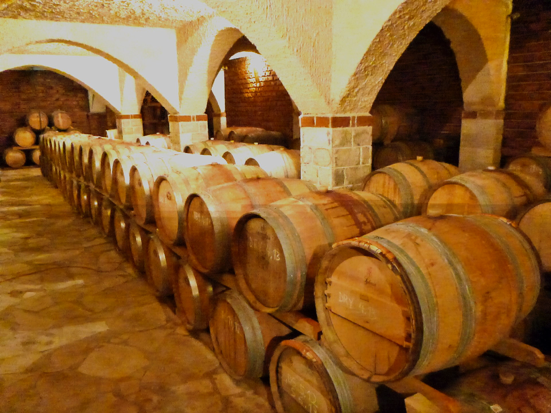
The first winery we visited was the Vinarija Matuška, a large winery for this area, but not large compared to the behemoths elsewhere in the world; the second one was a small winery. The third, Vinarija Madirazza, was a winery producing the wines of Barriques, certain types of wine aged in special oak barrels. All of them were very generous in the amounts offered for tasting and we were certainly glad there was somebody to drive us around.
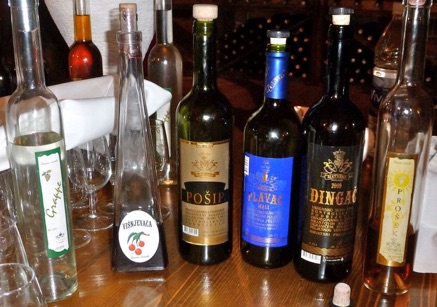
right: Matuška Winery offered us all these wines and spirits for tasting. Yes, all of these 6 bottles to understand the differences between these products. Good thing we had a driver.
This area is actually the center of red wine production in Croatia (well, that is what they tell us but there is some truth to this statement, especially since Mike Grgič has chosen to establish his winery on this island). The red wines from this region are often called "black" wines, because of it's extremely dark red color. No chemicals are used in the production, just maybe a small amount of sulfur as disinfectant spray.
The area is especially suitable for making exceptional wines. The ground is rocky and poor and the vines have to work hard to grow. They attribute this and the abundant sunshine as the main reasons for the high quality of their wines. Of these grapes the most well-known is the small Plavač Mali, or little blue grapes. The top quality red wine made from these grapes is the Postup, with production concentrated on the southern slopes of the Pelješac peninsula.
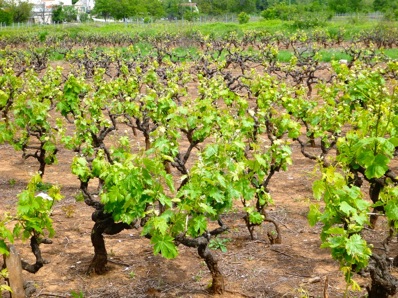
right: The vines of the Plavač Mali are not very tall. The soil is rocky, but there is a lot of sunshine.
The vines are small and usually not more than 50 cm in height. Yields are very low, only 1 - 1.5 kg of grapes/ plant.
The lower quality red wine can be diluted with water to make it the beverage of choice for all-day consumption for everybody. It is called the Bevanda, the lemonade for adults.
A higher quality wine is the Dingač, which is never served diluted with water, and which has an alcohol level of 14 - 15%. An even better quality wine is the Prosec. Parents of newly born babies will store a bottle or more of a high-quality Prosec, to be opened at his/hers wedding day. It has a sherry-like taste and the alcohol level is around 16 %.
From these wines stronger brews are also prepared by distillation. These can be a cherry-brandy with 25 % alcohol and a grappa with maybe 40 %+ alcohol. These are the two bottles on the left in the picture above, the Grappe on the left and the Višnjevača on the right. Everybody bought a bottle or two of the wines and/or the liqueurs; it was just too hard to resist. And because ship rules prohibit the guests from drinking alcohol from outside sources on board, we had to store our loot in the ship’s lockers for the duration of the journey. And Wally and Karen promptly forgot their wines when they left in a hurry at the end of the trip, because they were hugging everyone farewell.
White wines are mostly produced in the interior; production of the reds is concentrated along the coast. A lot of white wines are produced on Korčula, an island just west of the Pelješac Peninsula. The signature white wine of the island is the Pošip. These wines are usually full-bodied with flavors reminiscent of fig, berries, and honey. Very interesting and unusual in Korčula are the Grk (from “Greek”; the Croatians seem to have an aversion to vowels) grapes, which makes an excellent white wine. The Grk wine is uncommon because the Grk vine cannot reproduce itself, being all female. It needs another species in the neighborhood for reproduction. Production has usually been limited, but recently a number of new wineries have recently been established to increase production of this wine.
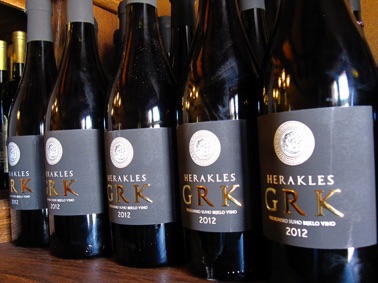
right: The Vinarija Madirazza had these 2012 Grk wines for sale. Aptly, they were named Herakles, the Greek champion Hercules who was also credited to have married 50 maidens and satisfied all of them in one night. Did he have these Grk wines for sustenance?. Earlier vintages are difficult to find, because of limited supply.
Most famous of the white wines is the Dingač, the name of which is registered for this particular region. These grapes are reminiscent of their cousin, the Napa Valley Chardonnay, which are derived from the same roots. A Dingač wine can actually be either red or white.
In between, we stopped to look at a monastery, which was regretfully closed, and I didn’t note the name. But we did make a group picture, which may be useful if you have to prove you were on this cruise.
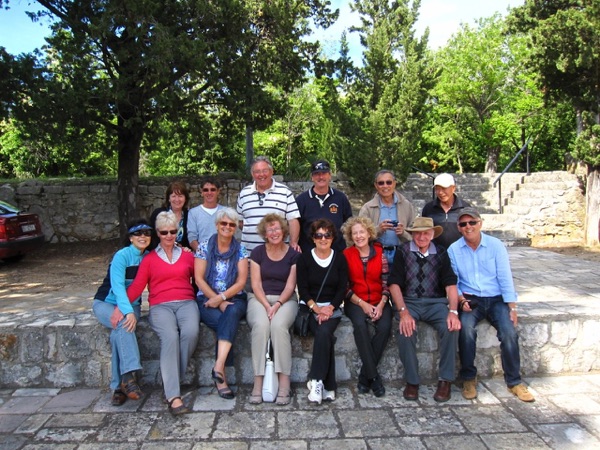
above: Standing, left to right. Christine, Wally, Fred, Jeff, Hok, Andrew. Seated are, left to right, Norma, Bette, Sue, Lin, Karen, Robyn, Alan, and John. I suppose that in Croatian the names would be spelled Chrtn, Wll, Frd, Jff, Hk, Ndrw, etc.
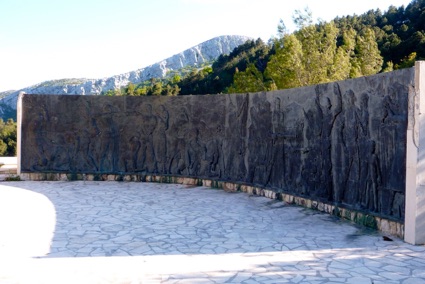
right: Memorial for the fallen from this area, mostly killed by the Germans.
Not everyone was happy with this monument; at one time some Serbs came by and pointedly put a lot of bullet holes in the main memorial spire to the left of this wall. There was not too much love lost between the Croats and the Serbs.
Dinner that evening was at Vitaceae, one of the local restaurants along the harbor, just across where our boat was moored. Norma was interested in oysters that evening. When we asked the restaurant barker whether their oysters were fresh, he led us to the quay in front of their building, where he pulled up a basket from the sea; it was loaded with oysters. Yes, they were fresh and they were wild, which means that they differed quite a bit in size from each other. Pearls; if there were any, would probably have been removed before the oysters were served. The oysters were Kuna 9, or around US$ 1.70 each.
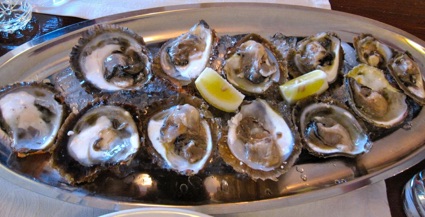
left: A dozen fresh, wild oysters, sans perles.
Somebody in our group ordered the octopus pasta. The octopus was fresh, just being pronged out of the Bay by a member of the staff that very afternoon. I mentioned that I was surprised that he was able to do that, and the waiter remarked that the octopus must have been even more surprised. The food was the standard grilled seafood, served by itself or in a pasta. Well prepared, there is not too much which can go wrong with these type of dishes.
Their red house wine was superb. I believe it was even superior to the red Grgič wine we tasted. A 750 ml bottle of red wine was Kuna 190, but a 200 ml glass of the house wine was only Kuna 16 . That doesn't seem right, and so we ordered two glasses of the red house wine and ordered two more at the end of our dinner.
There were some 16 passengers of our group in the restaurant and we were all having a good time. Summer had not quite come, and we were their only customers. So one of the waiters went away and came back with a bottle of his home-made Limoncello for all of us to drink. Which we all did; with gusto. By the end of the evening the bottle was finished and a lot of us were happily inebriated as we careened back to our vessel and beds. Surprisingly, none fell in the water when crossing the gangway plank. Which was just as well, as the captain and the crew were already fast asleep by that time.
4:25:18 PM