Wanderings in China-II

III: Suzhou
“In heaven there is paradise, on earth there are Hangzhou and Suzhou."
This is an ancient saying praising the beauty and prosperity of these two towns. But if you live in Suzhou, you quote: "In heaven there is paradise, on earth there are Suzhou and Hangzhou" to be sure you get the order right.
Then another saying is that the ultimate gift in life would be:
to be born in Suzhou
to live in Hangzhou
to eat in Guangzhou
to die in Liuzhou
Suzhou was famous for its beautiful women, Hangzhou is very pleasant, green, and delightful, Guangzhou with its Cantonese cuisine is unrivaled in this world, and in Liuzhou they make the best coffins from their unsurpassed quality pine trees.
Suzhou, formerly romanized as Soochow, is a major city in the southeast of Jiangsu Province in Eastern China, adjacent to Shanghai Municipality. It is second largest city in the province after its capital Nanjing. The city is situated on the lower reaches of the Yangtze River and the shores of Taihu Lake. Suzhou has a population of 4.3 million in its city proper, and a total resident population (as of 2013) of 10.6 million in its administrative area.
Founded in 514 BC, Suzhou has over 2,500 years of history. It is the cradle of the Wu culture, and it is one of the oldest towns in the Yangtze Basin. By the Spring and Autumn period of the Zhou (770 - 476 BC), a local tribes named the Gou Wu was recorded as living in the area which would become the modern city of Suzhou. This is where my ancestors came from and we still have the same surname.
For the tourists the main reason to visit Suzhou is to visit their famous gardens. We visited The Master-of-Nets Garden, the Liu Lingering Garden, the Humble Administrator Garden and the Couple’s Garden Retreat. They are covered in another chapter in this blog, called “Water Towns and Gardens in China”. Click here to get there.
-
(a) The Suzhou Marriott
From our hotel in Shanghai to the Suzhou Marriott was a 2-3 hours drive over the expressway. The Suzhou Marriott was in the Gusu district and was very modernly appointed. The bathroom had a free-standing bathtub as well as a roomy shower-stall. It was parallel to the sleeping area and had two entrances. It probably had been designed by a recent architectural graduate, innovative but not too practical. There were few hooks to hang your clothing and/or your laundry. The service was otherwise very good and I sometimes wonder how they were able to have so much staff in the bars and restaurants downstairs, just standing around waiting for customers to drop by.
It didn’t look at first that there were any eating places around. The concierge of course helpfully suggested that the hotel has several good restaurants. I presume he was instructed by management to say that. But Liam, young and energetic, cased the area on foot and found some good places to eat for us after all.
-
(b) The No. 1 Silk Factory.
Suzhou is a city with a long history of silk production and culture. Tourists are generally taken to this No.1 Silk Factory in Suzhou, founded in 1926 as a state-owned factory. The tour starts with a museum depicting the history of silk. it is then followed by a tour of the workplace, and then to their huge store-shopping display.
Silk from Suzhou has gained worldwide reputation from as early as the Tang and Song dynasties (618-1279 AD). During the rule of the Wanli Emperor of the Ming Dynasty (1573-1620), Suzhou was already surrounded by mulberry fields and was a prosperous silk producing area.
The silkworm creates its cocoon out of a single silk thread that is continuous for approximately 3,600 feet. The process to make skeins from the cocoons is especially important. The workers operate machines that spin the silk filaments into skeins. One cocoon is attached to each spindle. This is why the filament of each cocoon must be unbroken.
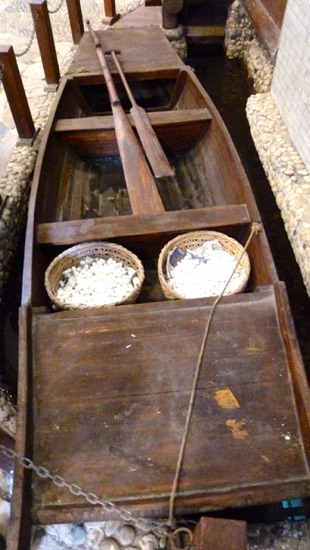
left: A boat transporting silkworm cocoons from the farm to the factory
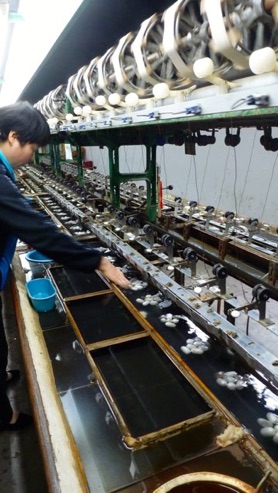
right: Mechanically unrolling the silk thread from the cocoon. Usually 4 threads are recovered at the same time and twisted together to make a stronger silk thread.
And even though this is a Government enterprise, you can and are expected to haggle over the price of the items you are interested in. This time the company was pushing their silk quilts. They are light as feather, very warm, and can be folded in a small package for transport. They can also ship overseas.
c: Tiger Hill
A famous Song Dynasty poet, Su Shi said, 'It is a lifelong pity if having visited Suzhou you did not visit Tiger Hill.'
Taking these words to heart, Tiger Hill (虎丘) Hŭqiū is now a popular tourist destination and is known for its natural beauty as well as its historical sites. The hill is so named because it is said to look like a crouching tiger. According to historical records, Fuchai, emperor of the Wu State during the Spring and Autumn Period (770 - 476 BC) buried his father Helu there. He was killed in 496 BC during the war against the Yue. Legend states that a white tiger appeared on the hill for three days to guard the tomb following the burial of the Wu King Helü. The location of the tomb is known but it has not been excavated because it is part of the foundation of the seven stories Tiger Hill pagoda.
The hill is 120 feet high. You can walk up the hill or take an elephant tourist train up.
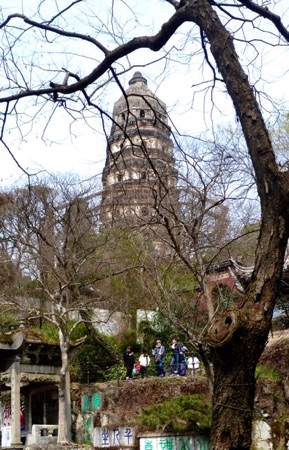
left: This pagoda stands on the summit of the hill and is the pagoda of neighboring Yunyan Temple.
This is the oldest stone pagoda in Suzhou and is also called China’s Leaning Tower, as it leans about 6 degrees to the northwest. The seven-story octahedron was built during the Northern Song Dynasty (959-961 AD) in the style of the timber pagodas built during the earlier Tang dynasty. Its height is 48 meters.
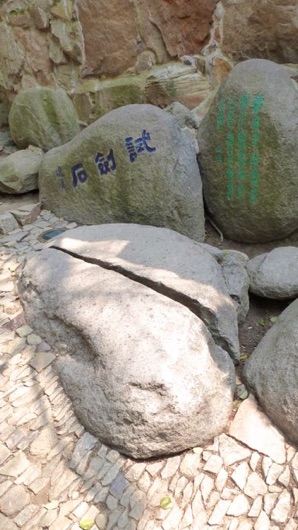
right: King He Lu was a zealous collector of rare swords and it is said that he tested them upon this stone. The crevice thus made in the rock is the only evidence of the existence of these swords, as it is believed that they were buried beneath the Sword Pool as funerary objects.
Another mystery that surrounds the tomb is the whereabouts of the remains of the 1,000 workers who built the tomb and who were put to death upon completion of their task.
To read more about king Helu and his son, king Fuchai, click here, where you will learn about one of the 4 ancient beauties of China, of love and betrayal.

left: The altar in the back of the Yunyan temple shows a smiling Goddess of Mercy and her attendants.
d: The Suzhou Museum.
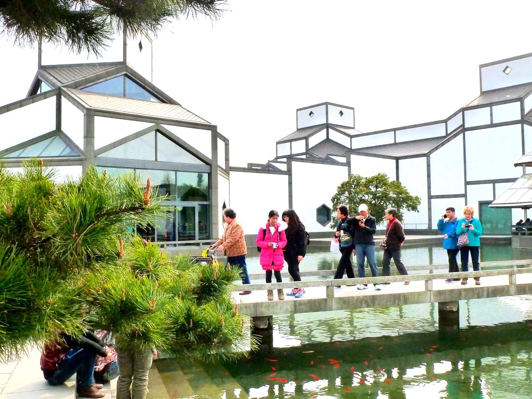
The Suzhou Museum (蘇州博物館) Sūzhōu Bówùguǎn, is a museum of ancient Chinese arts, paintings, calligraphy and handmade crafts. It was designed by the well-known architect I.M. Pei and inaugurated in 2006. He was born in this city. The emphasis of the collection is on the later dynasties, with works of masters of the Song, Ming, and Qing dynasties.
The museum, melding classical Chinese architecture with modern design concepts, is serene in its outlook, with a large pool in the back. It has a display area of 2,200 square meters, which is not very large and is situated adjacent to the much larger Humble Administrator’s Garden. Since this museum is situated in Suzhou, the hub of the Wu kingdom (one of the three kingdoms in the Period of the Three Kingdoms, 220 - 280 AD) of ancient times, their basic exhibition covers many Wu treasures, such as Wu pagodas, paintings, and calligraphy.
You can get current information about the offerings of the museum from their website, available in Chinese or English, but it is very slow and takes a lot of bandwidth.
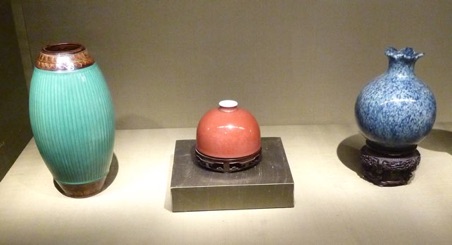
right: l to r.: Fish-roe green olive-shaped zun, Qing Dynasty, Kangxi period (1663-1721); Kidney-bean red Tai Bai zun, Qing Dynasty, Kangxi period (1663-1721); Snowflake blue pomegranate shaped zun with wavy spreading mouth. Qing Dynasty, Yongzhang period (1723-1736)
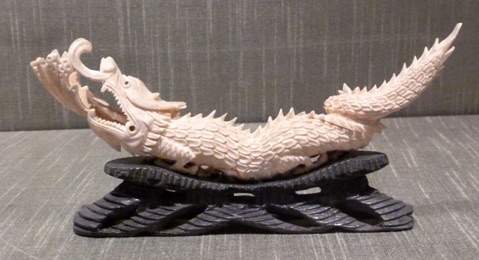
left: Ivory ornament with dragon design. Qing Dynasty, Qianlong period (1736-1795 AD)
e: Panmen Ancient City Gate
Pan or Panmen Gate (盤門; pánmén) is a historical landmark located on the south-west corner of the Main or encircling canal of the town, which is also part of the Grand Canal. Originally built during the Warring States period in the state of Wu, historians estimate it to be around 2,500 years old. It is now part of the Pan Gate Scenic Area.
There are three landmarks in the Pan Gate Area. These are (a) the Ruiguang Pagoda, which is situated at the entrance of the park, (b) the Wu Gate Bridge, and (c) the PanMen Gate itself.
The Panmen Gate is the only entrance of the ancient city wall built around 514 AD that surrounded and protected Suzhou. It is a combination land and water gate. There is a guillotine sluice on the water gate which is lowered from the stone platform of the gate above with a winch, so entrance can be closed and opened at any time. The city wall is 300 m long and 5 meters high.

The Ruiguang pagoda, the earliest pagoda in Suzhou and built in 247 AD.
This seven floor octagonal pagoda is 53.6 meters high, constructed of brick with wooden platforms. The Pagoda has simple Buddhist carvings at its base. It is said that the pagoda was built by Sun Quan, a famous king who established the Wu Kingdom in the Three Kingdoms Period (220-280) around 247 AD to show his respect to his mother.
In the ensuing years, the pagoda was badly damaged. In 1186 AD, the thirteenth year of the Chunxi reign of the Song Dynasty, a Zen master organized the citizens to renovate the pagoda. A white ox joined the work; he labored day and night, and died as soon as the project was completed.
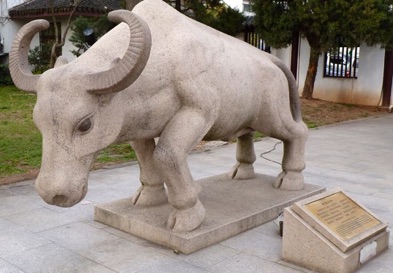
left: This modern sculpture of the white ox has been financed by the Suzhou Municipality to praise the devotion of this ox. The sculpture is next to the pagoda
The Wu bridge below was at that time the entrance to this gate. The bridge crosses the moat, which is also part of the Grand Canal, an ingenious transport network for its thriving silk industry. In the ramparts there are hence two entrances next each other, the water entrance and the regular land entrance.
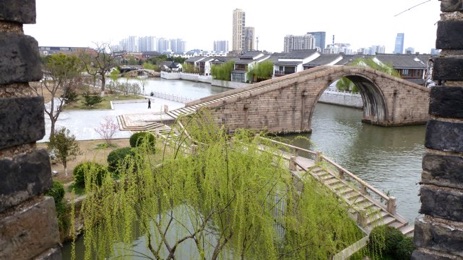
right: The Wu bridge as seen from the city ramparts.
The Wu bridge was, at that time, the tallest bridge in Suzhou
Below is the Panmen City Gate, claimed to be the best well-preserved water and land gate in the world.
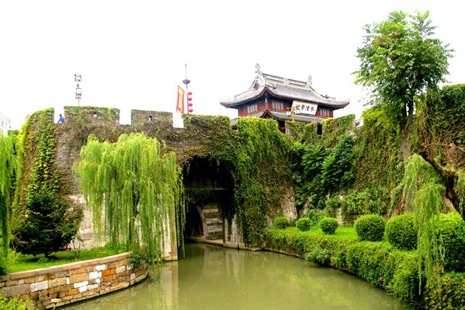
left: This is the watergate built through the ramparts.
On the platform of the ramparts above the gate are two sets of winches to drop 2 parallel metal sluices sliding through grooves in the walls to close off the opening. The enemy caught between the two gates can then be finished off at leisure. To the right, on the other side of the wall, is the entrance for the land gate.
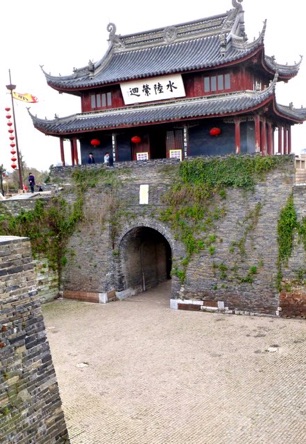
right: And this the inside of the land gate with its watchtower above. Here too, this area is walled with another exit gate. Enemy soldiers getting through the gate come out into another walled area where they can then be killed if needed.
The original Pan Gate was built in the 11th year of the reign of Zhizheng (1333-1370 AD) in the end of the Yuan Dynasty (1271-1368).The thriving city of Suzhou was well worth her extensive defense system.
f: Evening Cruise on the Ancient Grand Canal.
These cruises start from the Ancient Canal Port on Panxu Road at dusk. Passengers are squeezed into motorized, covered barges holding about 100 passengers. Each cruise lasts about 80 minutes. There is a surprisingly large interest in these cruises, as buses come in continuously to unload huge groups of homegrown tourists. The earlier cruises, just after dusk, always seem to sell out. The fare is not inexpensive, but they do give discounts to senior citizens. And looking at the lighted landscape from inside a warm boat is also quite pleasing. The cruise goes all the way to Shantang Street before coming back.
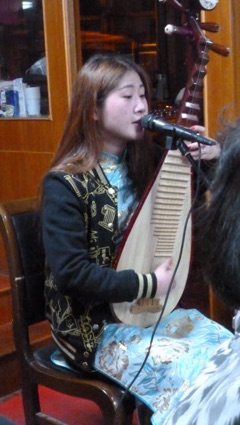
left: This attractive young lady was the tour commentator, singer, pipa player, entertainer, saleslady of tourists items they had on board, etc. She was talking, singing, joking, or playing the pipa almost continuously for a full 60 minutes. Am I glad, I am not married to her.
From the response of the audience, she was giving an entertaining commentary, which we regretfully, barely understood, because it was all in Chinese. She did cover “funny” terms and pronunciations people in Suzhou use when speaking the language. No wonder we have trouble understanding most of what she said.
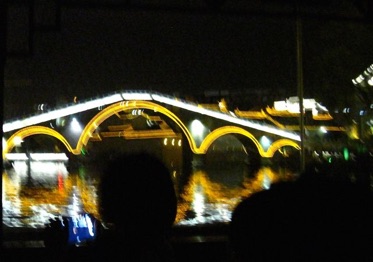
right: Many of the buildings and structures along the tour itinerary are lighted in various colors.
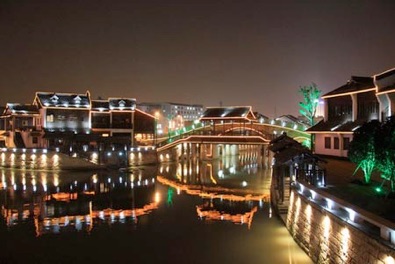
left: Here, close to Shantang Street, the cruise turns around
g: Shantang Street
Shantang Street, 山塘街, Shāntáng Jiē, an ancient riverside pedestrian road, more than 1100 years old, runs from the Changmen Gate (the west gate of the ancient city) in downtown, winds northwest on the northern bank of the Shantang River, and ends at scenic Tiger Hill. It is 2.2 miles (seven li) long, hence the other name used: ‘Seven-Li Shantang’.
In 825, Bai Juyi, a renowned Tang Dynasty (618 - 907) poet, became the governor of Suzhou, where he inaugurated the Shantang River canal project, which was linked to the Beijing-Hangzhou Grand Canal. A road ran on the north bank. The Shantang block became a busy transport and commercial hub and was called. ‘the First Street in Suzhou’ . Most of the tourist activities are concentrated in Old Shantang Street, about 360 meters long, one block parallel to the canal. Here are many guild halls, attesting to the importance of bygone eras. The scenery and architecture are still in traditional style.
Shantang Street now is a gemutliches tourist area, with great traditional architecture, eating places, tea houses, tourist shops and stalls, an outdoor opera building, bric-a-brac stores, and just people milling around.
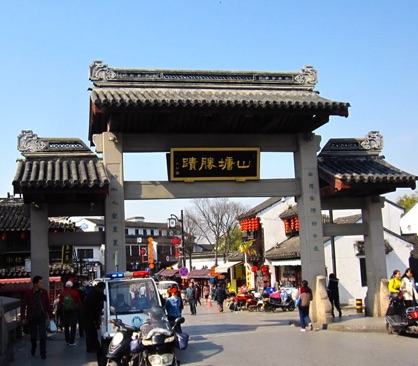
left: Changmen gate, the western entrance to the Shantang Street area.
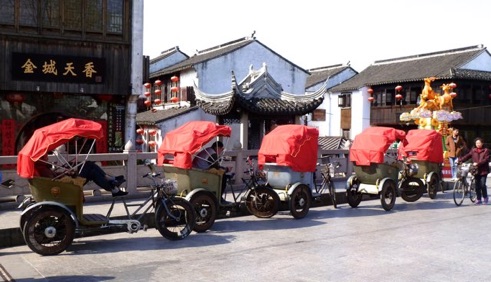
right: With so many rickshaws waiting patiently behind each other, you know you have just entered a tourist area. The entrance to Old Shantang Street is to the left of the furthest rickshaw.
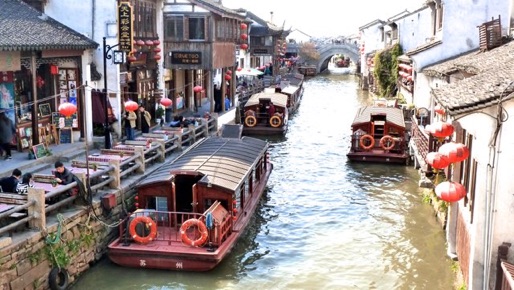
left: The canal runs a block parallel to the left of Old Shantang Street.
In the distance is the
dainty Tonggui Bridge
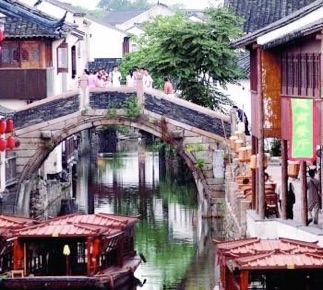
right: The Tonggui Bridge
There are eight side bridges on the riverbanks and seven bridges spanning the canal. The most famous is Tonggui Bridge, a single arch stone bridge. It is 21 yards (19 meters) long in its river crossing and 2.5 yards (2.3 meters) wide. Looking like a half moon, the aperture of the bridge and its shadow in the water form a perfect circle. The bridge is not unique, but it is the most photographed.
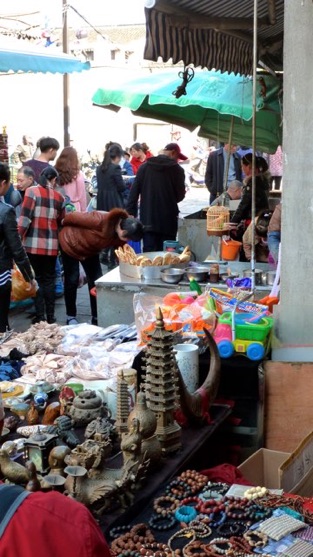
left: A store selling bric-a-brac, where Liam loaded up on some jade bowls. Adjacent to this store is a little food stall with a little pet bird in a cage.
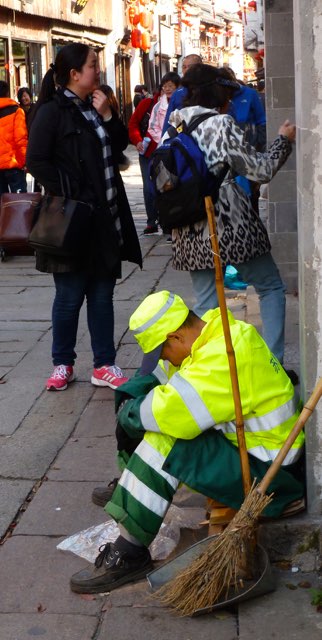
right: It can be somewhat discouraging trying to keep the street clean.
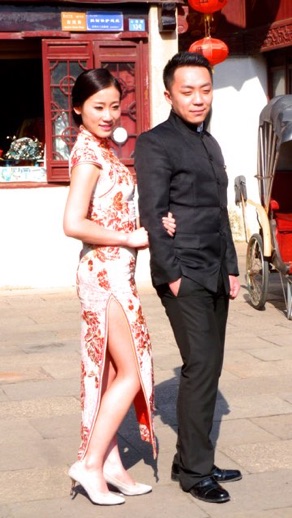
left: In contrast there was this nattily dressed couple adorning the tourist landscape. She does show a lot of leg, so she may be a performer in the opera.
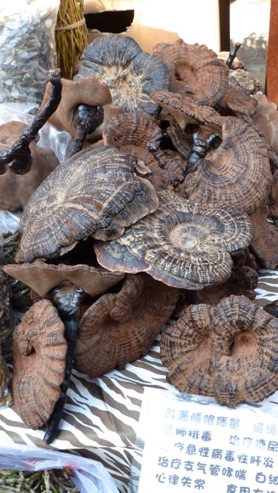
right: Old gnarled Chinese mushrooms in one of the stalls selling produce. I am sure they are medicinal, just from their fierce looks.
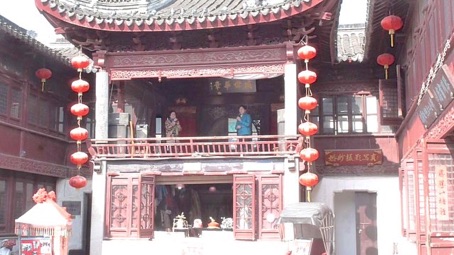
left. Before an open courtyard, these two singers were performing a Chinese opera for free.
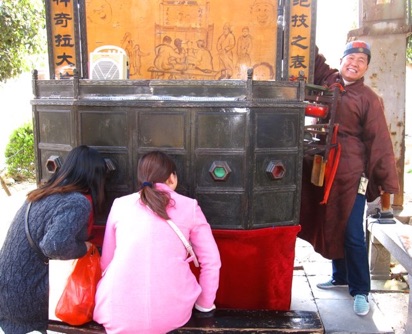
right: And if you are still young at heart, you look into this nickelodeon for a small fee. The operator provides the voices of the actors and also supplies the background music by banging on the drum and cymbals in front of him. It looks like he has a great time.
h: Chinese Tea House.
The Chinese tea house is a place to go for some serious tea drinking and to watch and listen to special entertainment. It is not a place for a casual cup of cheap green tea. Here we shared two pots of a black and a green tea for RMB 180, the price is discounted because the proprietor realized we were just some lost, thirsty foreigners. And of course we had to disappoint the performers who had been waiting all day for a gig.
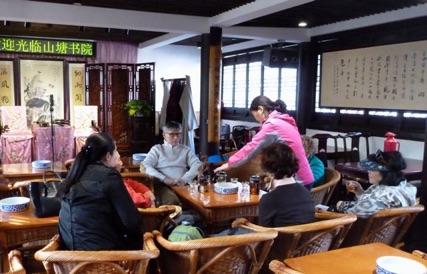
left: A tea house in Shantang Street. To the left in the back is the stage where you can engage performers to sing for you.
Saturday, March 21, 2015