Water Towns and Gardens in China

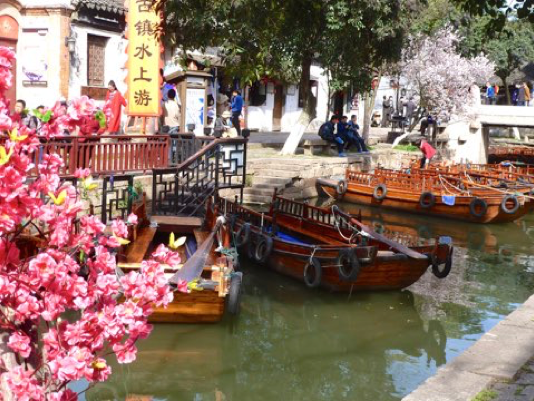

a: Water Towns.
Canals have been important for commerce and transport in China. In the late Spring and Autumn Period (722-481 BC), king Fuchai of the state of Wu, one of the three kingdoms in the famous “Romance of the Three Kingdoms”, ordered a canal to be dug for trading and military purposes, from the south of Yangzhou to the north of Huai’an. Work started in 486 BC. Subsequent rulers have increased the length of the original canal to what is now known as the Grand Canal. This wide waterway, 1776 km long, is still in full operation today, connecting Beijing to Hangzhou. Known also as The Great Canal, it is a major technological accomplishment. It is still the longest canal or artificial waterway in the world.
Along this canal many towns have sprung up, with their own canal systems, which are connected to the Grand Canal, just as many towns have sprung up next to major highways. These are quaint little hamlets, which have now often been transformed into tourist attractions with shops, teahouses, cafes, restaurants, and a plethora of eating stalls serving a wide variety of food.
There are, of course, quite a number of water towns vying for the tourist’s purse and attention. Each of them will tell you they are the very best and that you will be sorry for all eternity if you don’t visit them. It is just that in our lives, eternity is not long enough. I am only covering the three water towns we visited on our trip.
b: Xi Shi
I am taking the prerogative to digress here a bit to cover something I find interesting. King Fuchai of the State of Wu is mentioned above as the first ruler to order the Grand Canal to be dug. He has also been mentioned in the section on Tiger Hill, where his father is buried. But he is actually more well-known because of his relation to Xi Shi, one of the “Four Chinese Beauties of Ancient China”, women who have altered the course of Chinese history.
During the Period of the Warring States (467-221 BC) the three most powerful states were: (1) Ch'u, in the neighborhood of present Chongqing and Wuhan‚ (2) Yue, on the East Coast near the present Hangzhou and Shaoxing , (3) Wu, near the present Nanjing and to the east around what is today's Wuxi and Suzhou and all the way to the coast where Shanghai is now located. There was not much love lost between these three states as each was positioning for power.
Around 496 BC, Helu, the king of the Wu nation, attacked the nation of Yue, but he was defeated and died of major injuries received in battle. He is buried in Tiger Hill, covered in another chapter. His son, king Fuchai, decided to avenge his father’s death.
In a decisive battle in 494 B.C. the Yue were defeated by the Wu forces. The King of Wu, Fuchai, captured the Duke of Yue, Goujian. He then decided to subject Goujian to extreme humiliation by forcing him to serve, together with his wife, as slaves in his household. In this trying period Goujian forced himself to be humble and to appear respectful at all times as he performed his daily duties as a stable boy. He was released after 3 years of involuntary servitude.
After his release he resolved to concentrate on his revenge and he moved out of his luxurious palace into a thatched hut built outside the Ying'en Gate, facing north towards the State of Wu. This location today is called Xiguomen in Xiaoxing and tourists still visit the place. It was said that he slept on a pallet of brushwood and that he had a gallbladder hung over his head. Every evening he would taste the bitter gall to remind himself of his resolve. There is now a Chinese four-word idiom "Wuo Xin Chang Dan". (Reclining on firewood and tasting bile) to reflect bitter determination to fulfill a plan.
At a place called Ningluo in Yue there lived a very beautiful girl, who was said to be the daughter of a woodcutter and a washerwoman. Her name was Shi Yiguang. When she was orphaned at thirteen, she was brought up in the family of Fan Li, a minister of Yue. In one of the strategy meetings between him and Duke Goujian, Fan Li suggested that Yue send Fuchai several beautiful woman to distract his attention from state affairs. Fuchai was known to have a keen eye for beautiful ladies. Goujian thought it was an excellent idea and asked Fan Li for suggestions.
Fan Li then called Xi Shi and asked her a great favor for allowing Yue to send her to Fuchai to save the kingdom of Yue. Fan Li had in the meantime become widowed and Xi Shi had secretly fallen in love with Fan Li. Xi Shi replied that she was indebted to Fan Li for bringing her up when she was an orphan and that she would do what she was asked to do to save her country, the kingdom of Yue.
But from her reluctance he suddenly understood that she was in love with him. And he too fell in love with her. And in the night that followed they vowed to meet again and that he would wait for her to come back from Wu to marry her, even if the wait would take ten, twenty years, or longer.
When Duke Goujian learned that Xi Shi had agreed to go to Wu, he hired tutors to teach her elegance, dancing, court etiquette and skills. She was a fast learner in a short time she was fully trained and ready to go. "Our country depends on you" were the parting words of Duke Goujian. Xi Shi's beauty was said to be so extreme that while leaning over a balcony to look at the fish in the pond, the fish would be so dazzled that they forgot to swim and sank away from the surface.
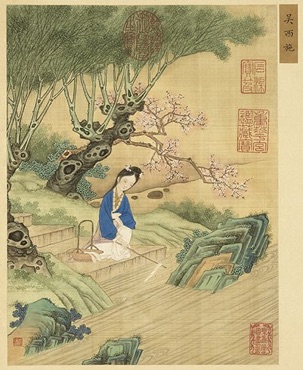
The moment Fuchai set eyes on Xi Shi he was captivated by her extraordinary charm, refinement, and beauty, and very soon he was spending more and more time with her. He commissioned the building of Guanwa palace and a large lake, about 15 km west of Suzhou, where dragon boats were placed for their enjoyment. The affairs of state were neglected. Xi Shi was secretly reporting to Yue on the state of affairs in Wu. Fuchai went to great lengths to please her, neglecting the affairs of the state and disregarding all news about the resurgence of Yue.
left: Xi Shi as shown in the manuscript “Gathering Gems of Beauty”.
Ten years later, In 476 B.C., Xi Shi sent the long-awaited a message to Goujian that it was time to attack and so he launched a sudden night attack against the State of Wu. Wu was caught completely unawares and their forces had to fight a hasty defensive battle. After several battles Yue was able to besiege and attack Fuchai in his remaining bastion, Gusu City. The Yue army encircled the city for two years. Running out of ammunition and food, the city finally fell in 473 B.C. Trapped in Gusu Tower, Fuchai sighed deeply and committed suicide.
There are many versions on what then happened to Fan Li and to Xi Shi. In one version of the legend, after the fall of Wu, Fan Li retired from his ministerial post and lived with Xi Shi on a fishing boat, roaming in the misty wilderness of Taihu Lake, and no one saw them ever again. The nicest story is that Fan Li left Yue and moved to Zibo in Shangdong province, where he established himself as a successful businessman dealing in pottery and terracotta wares. The location of his shop is known even now. And apparently Xi Shi was able to join him there for a happy ending. We don’t know.
c: Gardens.
In China gardens have reached a level of sophistication and beauty over the centuries. Chronicles report that emperors and nobles built hunting preserves as early as in the 11th century BC during the Zhou dynasty. During subsequent reigns, these preserves were made more beautiful and they morphed into places of recreation, rest, and introspection for the noble families. The heyday of garden building occurred during the Ming (1368 - 1644) and the Ching Dynasties (1644 - 1911).
As the saying goes, "Gardens in the south of Yangtze River are the best in the world, and Suzhou gardens are the best among them." Suzhou's classical gardens have an international reputation. As you will see, most of the gardens we visited were in Suzhou.
China's classical gardens can be divided broadly into two categories: the royal garden such as the Summer Palace in Beijing, or the private garden. Most of Suzhou’s classic gardens belong to the latter and which one is the best is determined with whom you speak, the time of day, and the position of the moon and the planets.
There is actually a surfeit of gardens to choose from for inspection and for enjoyment. Even if one would concentrate on those gardens which have received the World Heritage accolade this would still be quite a challenge for the uninitiated. We visited 7 gardens during this trip which, in retrospect, may be a little bit too much. They were (1) Tiusi Garden, (2) Master-of-Nets Garden, (3) Liu Lingering Garden, (4) Humble Administrator Garden, (5) Couple’s Retreat Garden, (6) Mr. Guo’s Garden Villa, and (7) the Royal Gardens in the Summer Place. Things start to blur, as you basically see the same components, in different configurations and in different sizes and degrees of sophistication.
One of the most well-known, and certainly the largest, is the Humble Administrator Garden. There is an interesting story somewhat related to this place below:
d: General Wu Sangui and Chen Yuanyuan
This is another of my digressions. Chen Yuanyuan was a beautiful entertainer in the court of the Ming emperor. She was also the beloved of general Wu Sangui, the Ming general in charge of guarding the northeastern borders of China against incursions of the Manchus.
In the last years of the Ming dynasty (1368 - 1644 AD), there was widespread corruption and heavy taxation. There was a severe famine in the land and yet the officials insisted that the farmers paid their taxes. This led to an uprising of the people in the countryside. There were several peasant leaders, but the most well–known man was Li Zicheng. Under his leadership his men were welcomed by the broad masses and the number of insurgents grew rapidly. As they moved to the capital, the Ming forces surrendered one after another. As they entered and captured Beijing, the Ming emperor, Chongzhen, had nowhere to go and so he ended his life and his lineage by hanging himself on Coal Hill.
The tourist guides in modern Beijing will always point out this location as the place where the last Ming Emperor died. But in this process the rebel forces also captured Chen Yuanyuan. Wu Sangui was at that time stationed at the Shanhaiguan Pass to protect China from the Manchus from the North. He was otherwise known as a brave soldier and an able commander, but he felt that the remaining Ming forces under his command were insufficient to quell the rebellion. He also heard that Chen Yuanyuan was now the object of desire of the rebel leader Li Zicheng. So rather than taking the risk of losing her, he threw caution to the winds and allied himself with the Manchus, the barbarians to the North.
The combined armies did manage to defeat the rebels and allowed Wu Sangui to rescue his lady love. But this step opened the gates for the invasion of the Manchus into China. They were now inside China; the rebels were defeated and the last Ming emperor was no more. That was the end of the Ming dynasty and the beginning of the Qing dynasty.
The man Wu Sangui turned to was the Manchu emperor Huangtaji. He later became known as Emperor Taizong, the first emperor of the Qing dynasty (1644 - 1911 AD). And the Qing was the last dynasty in China before the country became a republic. In a sense one can say that Chen Yuanyuan was one of the major factors in the formation of the Manchu or Qing dynasty.
Helen of Troy was said to have a face that launched a thousand ships. Even though Yuanyuan is not listed as one of the Four Great Beauties of China, she must also have one which, as the similar sonorous opening and closing stanzas of the "Annals of the Three Kingdoms" state, is the cause why "States fall asunder and reunite; empires wax and wane"
So why do I bring up this story here. General Wu Sangui had betrothed his daughter at a very young age to a young boy. The family of the boy came upon hard times, but when the young man approached General Wu with the betrothal documents, the general was honorable enough to acknowledge the troth, even though the boy was poor. The couple married and they were subsequently appointed as caretakers of the Humble Administrator’s Garden until the husband’s death.
Wanderings in China - II
This chapter is closely associated with the material described here. To get there, click here.