Wanderings in China - II

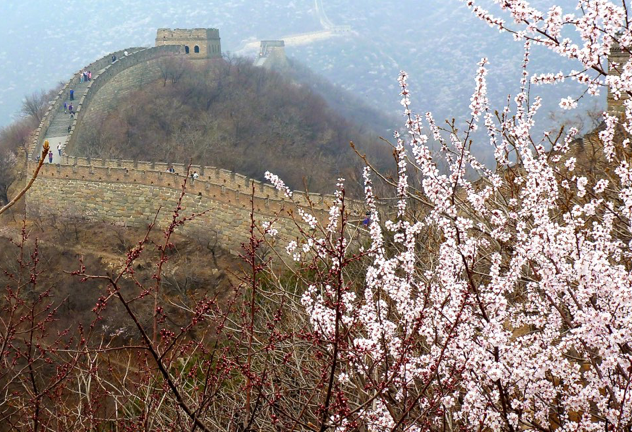

In the spring of 2015 we went back to China for a three-week visit to Shanghai, Suzhou, Hangzhou, and Beijing, mostly to see how things have changed in the last few decades. This was the eighth time I have been in this sometimes enigmatic country, the first time in 1980, and the last time in 2009. A few of those trips I have covered separately earlier. We will be in China a ninth time later this fall; nine is a lucky number in Chinese, since one of its homonym means old age or long life.
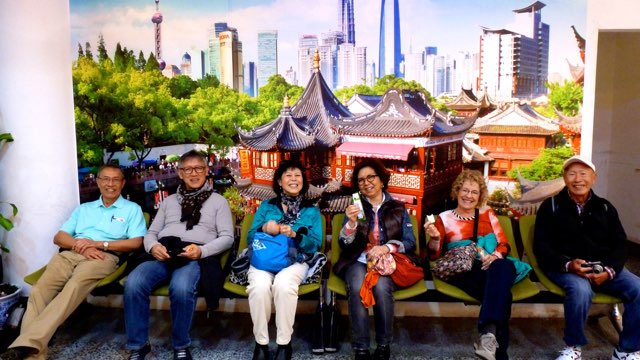
From l to r. Hok, Liam, Norma, Gerdy, Robyn and Andrew in front of a fake view of Shanghai. Liam and Gerdy are from the Netherlands, Robyn and Andrew are from Australia. Wow, do these people look relaxed.
This time there were six of us, down from the original eight. Our long-time friends and travel companions, Khoon and Hiang had opted out a few days earlier for health considerations. Yes, we are all getting older.
Well, how is China this time around? The most obvious thing is that the economy is humming and people are doing well. The healthy charging bull on the Bund is a recent addition we have never seen before and is an apt symbol of current prosperity and the skyrocketing local stock market.
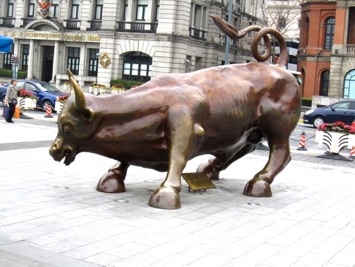
right: The new roaring bull on the Bund.
We know there are lots of people in China, and many of them now have lots of money in their wallets. Seemingly everywhere are automobile showrooms for top-end cars such as Mercedes, Rolls Royce, Maserati, McLaren, Ferrari, Alfa Romeo and Lamborghini. But in a seemingly contradictory move by the Government, the high-ranking brass have stopped using Mercedes as their official cars to combat the image of profligate spending. They have switched over to the more discreet black Audi 6. Which are still expensive cars, of course.
The increasing prosperity results in different emphasis on your goals in life. I recently read the following conversation in Quora, the on-line advisor website by a person named Peter Niu
“I had this conversation last year, 30 minutes into a first date. We were both 25:
Girl: "So Peter, how much do you make each month".
Me: "Um... [an amount]".
Girl: "That's not bad. Have you bought a house or a car yet?"
Me: "Neither. I want to invest my income into education."
Girl: "Don't you think as a man it is your responsibility to own a house or car?"
Me: "..."
I don't know just how prevalent this is but all of my male friends in Shanghai and Beijing report having experienced various versions of this conversation, whereas in the UK I'd have found this baffling.”
And so, to feed this growing appetite for symbols of economic success, there is also the seemingly ubiquitous multi-level shopping malls with high-end boutique stores, open until 10 p.m. almost every day. They must have good turnovers, just to be able to exist, even though, if you walk through at 9 p.m., the shops are already deserted as the sales ladies forlornly sit waiting for a final high-spending customer to make their day. But luckily, most of these shopping centers do have something useful, which is their basement level. There you will generally find many small and cozy eating places. Well, the staff of all these expensive stores do need a reasonable place to eat too.
You suddenly realize that many, if not most, clothing in these high-end boutique stores are now actually produced here in China. A few decades ago, Japan was the source of many cheap and shoddily manufactured goods; in a decade they have evolved into a country producing quality cars and other technical innovations. And not many years ago China was the source of cheap products, also because labor was cheap here. This is not always so anymore. China still produces a lot of very-low priced merchandise. But in Senzhen most of the high-end men clothing for the world’s top fashion designers are now produced there. There they pay their laborers maybe $600/month, compared to $60/month in Bangladesh. China cannot compete on labor cost anymore; they now have to compete on quality on the high-end world markets.
An article published in 2014 in the China Daily notes that the average salary in Shanghai was $1163/month. Living expenses in China are still quite low. There is more disposable income. Of Apple’s 2015 first quarter sales, 1/3 originate in China.
As incomes rise, its population travel and go out more. The picture below is of Nan Luo Gu Xiang Street, a popular shopping street in Beijing, about 1 km long, lined with tourist shops, snacks stalls, cafes, restaurants, handicrafts, etc. etc. Almost everybody on this very crowded street is young, vibrant, and Chinese and the shops do a roaring trade. This is typical of China and indicative of the mood of the country. But this is what we encounter almost everywhere; lots of other Chinese people, all on the go.
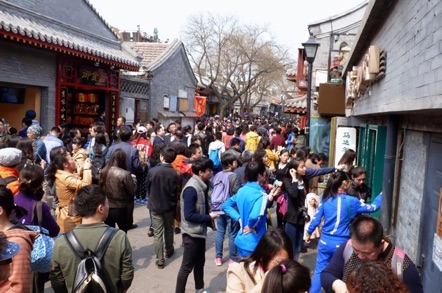
left: Nanluoguxiang street is typical of the Chinese landscape. Young, Chinese, going out and having a good time. To the right is a shop selling take-a-way food.
Surprisingly, there was much less smog than we remembered and expected. We were told with some pride that a number of coal-burning electricity generating plants have recently been closed in the area, their function replaced with other less polluting power plants.
Maybe the weather was also a contributory factor. There was an occasional drizzle in the days we were there, and that might have helped to clear the air In the earlier years I have visited the country, the sky had never been as blue. In all my previous trips I would look at my printed hazy pictures and wonder whether there is something wrong with my camera. Not so this time. The air is not as clear as in pristine Tasmania, but good enough. Also, there are now very few people walking around with an ugly preventive gauze mask over their noses.
China has a landmass at least as large as that of the USA, but it has four times as many inhabitants. That makes it more difficult to improve the environment and to promote conservation. But even then, I was informed that now more than 3,500 environmental groups in China are working to curb pollution, conserve land, and protect wildlife. As part of their three-phase GreenGen project, in development since 2005, and estimated to cost over $1.5 billion, an energy plant opened past spring in Tianjin outfitted with the latest carbon-capture technology, allowing it to burn coal with no release of carbon dioxide to the atmosphere. China has recently, for the first time, pledged to cap its CO2 emissions by 2030 and China’s State Council recently announced a cap on national coal consumption by 2020. Government data showed that national coal consumption fell by 2.9 % in 2014 - the first time this has happened this century. It is also true that China is one of the countries most vulnerable to the adverse impact of climate change.
There had been clearer days before, of course, especially in Beijing during the recent Olympic Games. The Government shut down most factories around the city for a few weeks, and severely curtailed the freedom of their private cars to drive around. They still do this now. By prohibiting cars ending with certain numbers to drive on certain days, this reduces the amount of automobile traffic by 15 %, essentially limiting a number of cars from driving one day a week. I suppose the car dealers like this; they’ll be selling more cars. Well, if you are rich, you just buy more cars to obviate this problem.
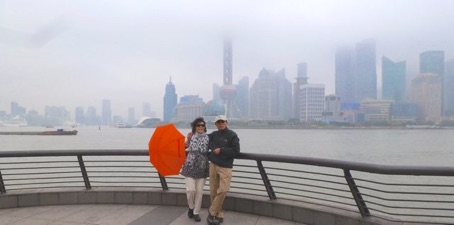
right: A picture from the Bund across the HuangPu river, the usual promenade for all Shanghai tourists visiting the city. It is called the Whampoa river in the old days.
The background looks like smog, but it actually a low-hanging fog layer, with the viewing platform of the high Pearl TV tower way in the clouds. These clouds dispersed later that morning and the weather became clear all day.
The skyline has changed; as can be expected. There are many more skyscrapers, some gaudier than others; there is less and less free space. The high-rise apartment buildings are of better quality; they can still be monotonous and faceless, but they do try to make the newer ones more interesting. The city is losing its personal charms and becoming one of the many nameless metropolises on this planet. But sometimes, in this sea of high-rises there are areas where buildings are still low. This is because of a temple or another ancient building in that area. But the place is probably chock full of tourists and visitors.
Traffic in Shanghai was bad the last time we were there, it is still bad today. A decade ago there were swarms of bicycles on the roads dedicated to the lowly pedal pushers along the main arteries. Now there are much fewer bicycles, they have been replaced by cars which, of course, spew out more toxic gases and occupy more space. The lanes where bicycles used to reign supreme have been invaded by automobiles trying to gain a few precious milliseconds by taking to the roads parallel to the main drag and to take advantage of every free square inch available.
It is difficult to drive in the large cities in China. The free space between vehicles is substantially less than what we see in other countries, it also has probably a shorter life span. There is always somebody who cuts right in front of you to occupy that space. It takes strong nerves just to sit in the front passenger seat. But surprisingly we didn’t see any accidents when we were there. Chinese drivers are in general very adept. I suppose they wouldn’t last very long if they weren’t. They are the opposites of drivers in Alaska, where you stay generously away from surrounding cars. Well, that is because in the winter the road can be slippery and you may well slide in an unintended direction, and you still do this in the short summertime.
Driving in China is not for the faint of heart, because cars drive very close to each other at what is for us reckless speed. Well, you have to take any opening as soon as it is available. And this is what can happen.
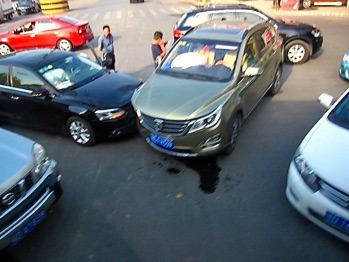
left: Collision at intersection in Yichang; the black oil spot does not forebode well. I am actually surprised these encounters don’t happen more often.This one looks like there was a big bang. I am also surprised there were not more gawkers standing around. I suppose these things happen so often they are not interesting anymore.
Traffic lights in China sometimes seem to be mostly for decorative purposes only. When a traffic light turns red at an intersection and the pedestrian light for crossing the street turns green, do not assume motorized traffic will stop to allow you to cross in tranquil safety. Most of the automobiles going straight through will probably stop; not so for cars changing direction to the right and sometimes also for cars going to the left. Motorcycles and bicycles completely ignore traffic signs, weaving in and out trying not to bowl over an unsuspecting pedestrian. Even on the sidewalks the pedestrian is not always safe. Silent, battery powered motor- and bicycles still go full blast on these lanes, blowing their horns or bells to warn of their impending arrivals. The safest way is to walk steadily and purposefully in a predictable direction and pray that the surrounding wheels will successfully avoid you.
The subway is fast and efficient, and it is a wonderful way to get around rapidly. Trains seem to go almost everywhere, running every 90 seconds on some routes during rush hour. You will still see people offer their seats to older men and women. The teachings of Confucius to respect your elders are, surprisingly, still being followed to some extent. Or maybe it is because we just look old. Without the subway, the city would have gridlock almost all the time. The underground railroad system is sleek and efficient, with clean underground stations, clearly marked in Chinese and also in English So, once you get the hang of it, it should be easy to travel.
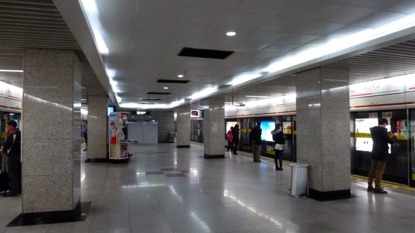
left: Subway stations are clean, and the system runs very efficiently.
They do X-ray your big shopping bags and backpacks to look for suspicious stuff. Which includes bottles of water. But instead of having to dispose of them, as you see in airports safety checks, you can take a big gulp in front of the officer to prove that it is harmless. Or you can place the plastic bottle on a special machine which, in a few seconds, will scan the bottle to determine the safety of its contents.
Traveling by taxi is fine and relatively inexpensive. There is a meter, and you are not expected to tip. You can still do so, of course. But during rush hours it is a dicy proposition. All the empty taxis are generally taken, and you may spend inordinately long times trying to flag an empty vehicle for hire. The free ones will refuse a fare if the path goes through a “difficult” area, or demand an extraordinary large fare, because their meter does not register much fare if they are stuck in traffic. There are also the occasional unmarked car and van who will stop by and ask whether you want to go anywhere. They are not recommended by the authorities, but if you have been futilely trying to flag something down for the better part of an hour, you’ll take it if the price is reasonable. We had taken these cars a few times, with no problems. But do ask for the price before you step in.
If you are a local, you can of course use a taxi hailing app, such as Uber. In China, the two dominant taxi hailing apps are Kuaidi Dache and Didi Dache, but if your Chinese is not fluent, it will be difficult to use those apps effectively. I speak some survival Chinese, but not enough to be able to explain to a taxi driver where we are. I was able to install a local Chinese Sim card in my IPhone 5, and it is always puzzling to get all the messages in Chinese. I found out that most of them are advertising, which you get if you have a cheap Sim card.
If you are obviously a tourist you are, as everywhere else in the world, always fair game. In the Shanghai airport touts will approach unsuspecting passengers and offer taxi rides at grossly inflated prices. The ride to our hotel, the Renaissance Yangtze, was quoted by our hotel as being around 200 RMB, but it was rush hour and we were quoted 800 RMB. We settled for 400 RMB but it would probably have been better just to go to the taxi stand in the airport.
A major improvement is that the city and the public places are pretty clean. You see street sweepers everywhere. When visiting an ancient attraction in the past, we would be wallowing in discarded cigarette butts, soiled food wrappings, empty plastic bottles and other trash, which the average Chinese happily just throws away on the ground or preferably in the decorative fountains. Now they actually use the trash cans. They don’t spit on the streets anymore, something which they had been doing before almost everywhere, and sometimes even in the spittoons. Which have now also been removed. Thankfully.
Last but not least, of major importance for the older traveler, are the many clean, Government-run public toilets. They are now almost everywhere in the big cities and along the major highways. It is nice to know that people would reply affirmatively to: “duibuqi, cesuo shi zai nali”, excuse me, where is the bathroom. You will be barraged by a stream of incomprehensible terms, but just look where he or she is pointing and soon you will be in the Temple of Immaculate Relief. Driving on the highway from from Hangzhou to Shanghai, we saw a big sign on a building, easily readable from the highway, saying “Toilet”. And that toilet was clean and free. This is more pleasant and civilized than in some of the rest stops we have visited on earlier trips.
Water towns and gardens.
These are covered in a separate entry. Click here to get there.

Blog Summary Widget