Crossing the Atlantic

1: Ft Lauderdale, Ponta Delgada
a: Port Lauderdale.
This is a very busy port where as many as 4 cruise ships would be moored at anytime during the day for loading and unloading. For nightlife and for some of the more interesting sites, one would probably go to Miami, relatively close by. For beaches, you could stay here or go to Miami. There are many interesting places to visit both here and in neighboring Miami, but most passengers just take a cursory look at the attractions before they rush to board their cruise ship for the anticipated associated pleasures. But here are some of the places we have visited and found them interesting.:
1: Little Havana Restaurant.
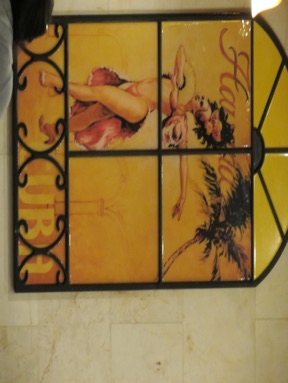
left: A glass in lead piece in the back of the restaurant.
We love to have dinner in this restaurant, located in N. Miami on 12727 Biscayne Blvd. The food is excellent; and the service is good. The lingua franca is Spanish, but they will seamlessly switch to good English if the patron prefers.
Prices are reasonable. As the name implies, what they serve is Cuban food. Not what you can get in Cuba at this moment, but food as it was and/or what it has to be. The comparison is not fair because of the current long-term embargo on Cuba, where many things are currently not available on the island to sustain haute cuisine. Which includes a good-sized upper-middle class able to patronize good restaurants. But the growing stream of tourists to this island is helping a bit in this respect.
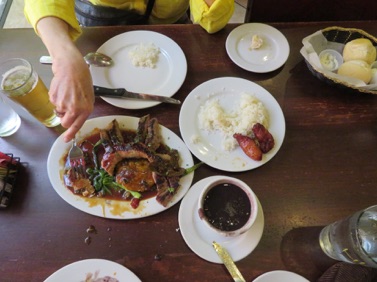
right: Our favorite dish halfway through our meal.
Our favorite is one of their specials, the grilled pork tamarind. Superb. It is grilled and served with a sauce, rightly balanced between sweet, sour, and tangy. It is served with white rice, plantains, rolls, and black beans. One order is large enough to satisfy both of us. We are not big eaters. We also have beer, coffee, guava flan cheese dessert, and the bill was just over $30.
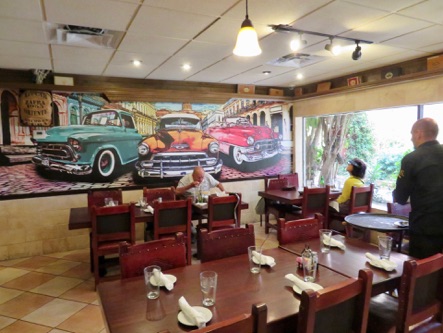
left: A huge mural on the wall showing the famous “Almendrons” , the well-restored, beautiful, old taxis you find in Cuba, especially in Havana.
2: The Wynnwood Walls
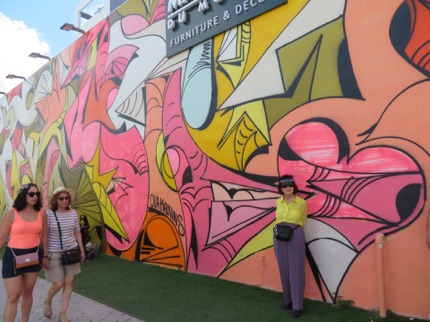
In the early 2000’s, this area in Miami was an industrial urban neighborhood fallen on hard time. There were empty buildings of failed businesses, abandoned warehouse, blight, and crime. In this bleak landscape pedestrians were far and few between. You don’t want to be here unless you have to be here.
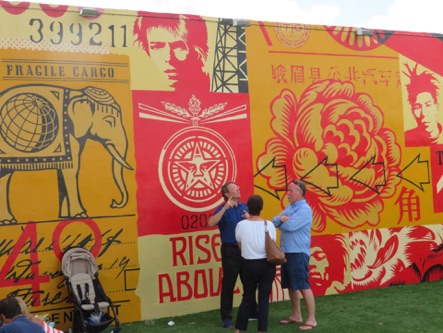
left: More wall murals in Wynnwood.
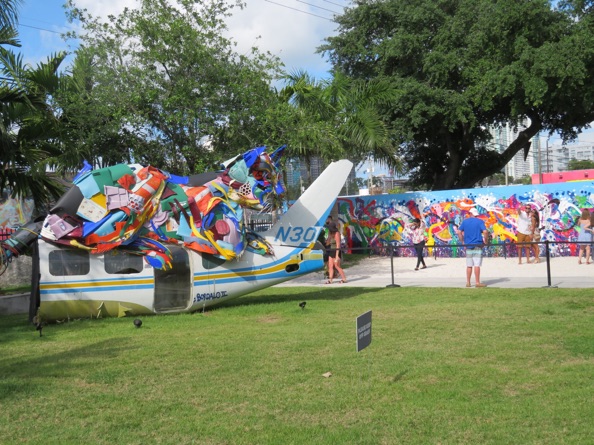
Tony Goldman, founder of Goldman Properties, saw this sad surroundings, and had this vision of transforming this area into a town center where the walls would be used for the canvasses for street artists, and thus attract visitors to come here and enjoy this world of street art. And this includes the sidewalks, spray painted with quotations you can immortalize on Instagram. Now, some 20 years later, the walls of the buildings have been adorned by creations by over 100 artists from more than 20 countries. In this area of several blocks, the center is the “Wynnwood Walls”, on NW 26th street and NW 2nd Avenue. You will find artwork everywhere in this area, but most of them are concentrated in and around the Walls. The whole area is now a thriving art district.
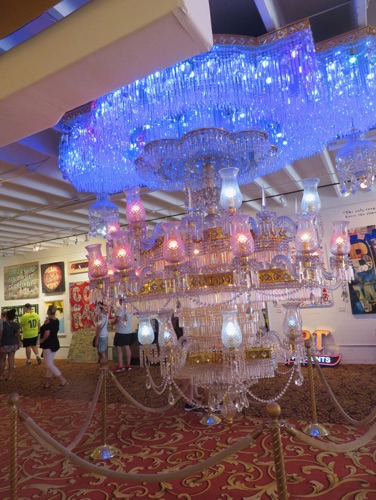
Right: Glass displays in the Wynnwood Walls complex.
This area has also evolved into an established tourist venue, and bistro’s, restaurants, independent boutiques, tattoo parlors, smoke shops, souvenir shops, etc. have sprouted up everywhere. On nice days and on weekends the area is full of visitors and the main street in this area, NW 26th Street, is usually clogged. If you call for an Uber there, you have to wait for some time before the driver can get to you.
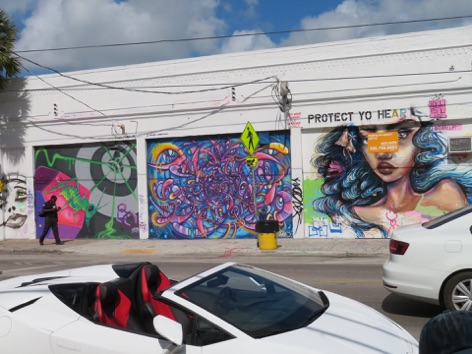
left: More street Art.
You drive there, you will have parking problems. The garages around charge exorbitant rates; street parking, if available, is susceptible to break-ins, if you leave too much of your goodies in full view.
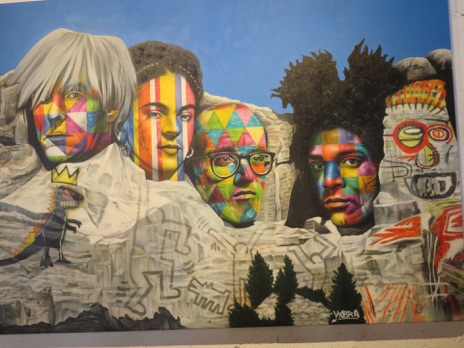
left: And this work is by Eduardo Kobra showing Mt Rushmore with the effigies of current top artists; Andy Warhol, Frieda Kahlo, Keith Haring, and J.M. Basquiat.
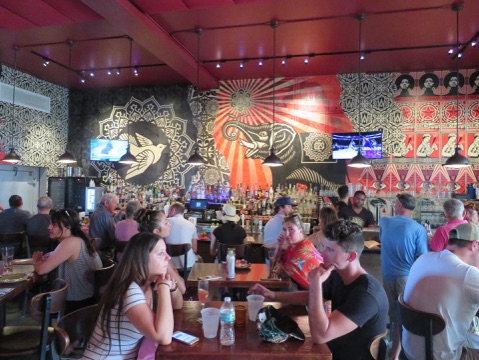
right: Joey’s Italian Café.
This café/restaurant is right at the Wynnwood Walls. It is always very busy, because they are the only one close to the Walls. And they have bathrooms, admittedly for their clients only, but used by about everyone in the know.
3: Wiener Museum of Decorative Art (WMDA)
The WMDA is a non-profit museum located at 481 S Federal Highway, Dania Beach, and is one of the most under-appreciated fabulous museums anywhere. When we were there, there were maybe only 10 other visitors in the whole building. The museum is in a rather seedy looking area, and you have to ring a bell to be let in. But what they have is amazing stuff.
The Museum was founded in Dania Beach, Florida in 2014 by Arthur Wiener and family. The museum specializes in the fired arts of ceramics and glass. Visitors will be amazed to see the beautiful pottery and porcelain from the 18th century to the present day. The collection has stunning pieces of the work of the upper echelon British pottery pioneers, such as Josiah Wedgwood and Sir Henry Doulton; the collection also has stuff from European designers from the Art Nouveau and Art Deco eras.
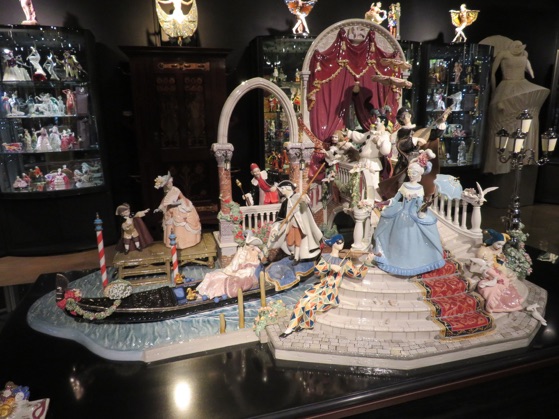
above: Carnival in Venice.
Carnival in Venice is one of the greatest artistic and technical challenge undertaken by the Spanish Lladró porcelain brand. It took them 5 years of research and testing and some 22,000 hours of work were provided by some 35 artists. This assembly has 450 pieces, and shows 14 different characters, mostly inspired by commedia dell’arte. A limited edition of just 100 units were produced of this work. I wonder how much one set would be quoted at The Antique Show.
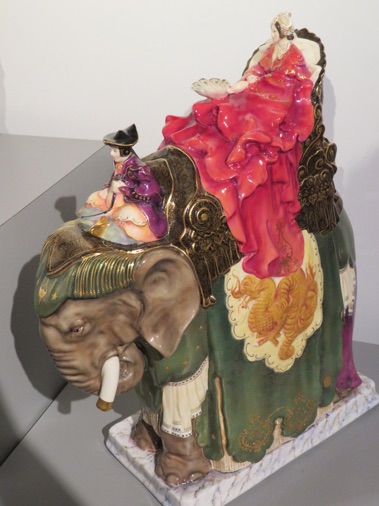
left: Princess Badoura going to her wedding.
In the Tales of the Arabian Nights, Badoura is a princess of China and the most beautiful woman ever seen on earth. In her sleep she magically falls in love with Prince Camar of Persia. In defiance of their families, the young couple steadfastly refuse to marry anybody else after a quest for each other across Arabia. Their dreams come true and the princess travels to her wedding in great splendor on the back of an elephant.
The piece was modeled by Harry Stanton as a centerpiece of the Wembley Exhibition in 1924 as part of the Royal Doulton HN Collection. The laborious decoration required over 160 hours of intricate paintings and 5 kiln firings before the final 22 carat gold was added.
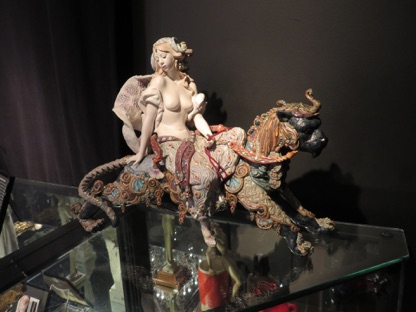
right: Spring.
This exquisitely chiseled work was
created by by professor Richard Garbe and produced by Royal Doulton in their factories in London and Stoke-on-Trent. This artwork was inspired by Garbe’s original work in ivory.
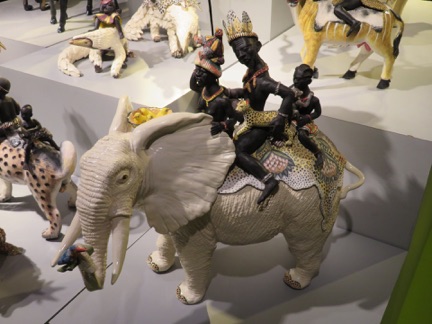
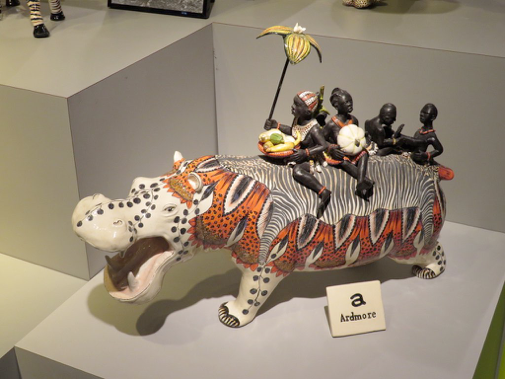
left: An interesting piece from Ardmore Ceramics.
Ardmore Ceramics is an extraordinary South African success story. It has grown from a farm into a vibrant studio with some 50 sculptors and painters. It is now South Africa’s largest ceramic studio with collectors all over the world, including the White House and Queen Elizabeth’s castle in Balmoral.
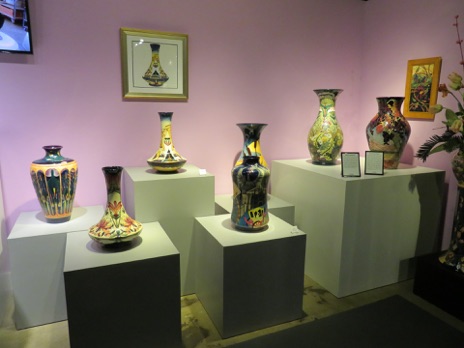
right: Pottery from the Moorcroft Design Studio.
Walter Moorcroft created the Moorcroft Pottery, but he sold it in 1987 to Hugh Edwards and Richard Dennis. Richard’s wife, Sally Tuffin, became the Design Director. The new Moorcroft Design Studio was established in 1998 and employs a team of young designers reviving the elegant art nouveau style of floral decoration. Moorcroft pottery continuous to be hand-made today at the original pottery location in Stoke-on-Trent.
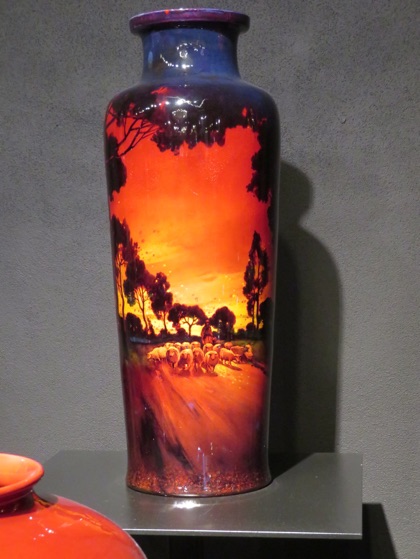
left: A rouge flambé vase by Royal Doulton
In the early 20th century, the British Potteries performed many experiments with glaze to revive the rouge flambé glazes of the ancient Chinese potters. Glaze chemists at Royal Doulton developed formulas for high temperature transmutation glazes.
The exact process is still a closely guarded secret, but essentially the metallic oxides change color when oxygen levels are reduced in the kiln firing and copper then turns red instead of green.
Royal Doulton launched their new flambé creations at the St Louis World Exhibition in 1904, to great acclaim. By 1920, they had developed feathered, veined , and mottled effects in blues, purples and yellows. Images of exotic animals can then be painted under the flambé glazes.
Known as Sung Wares, they were named in honor of an ancient dynasty of Chinese potters.
In the glass galleries at the Wiener Museum visitors can also admire the art of French designer Renée Lalique and Venetian maestros from Murano, as well as local glass artists working in South Florida. A highlight of the Hot Glass gallery is a nice collection of Chihuly’s glass creations.
An overview of the museum can be seen on https://www.youtube.com/watch?v=3J45T6EcoxY
(b) Ponta Delgada
Ponta Delgada is the largest municipality in the Azores, a complex of small islands belonging to Portugal. On the map they are all alone in the vast Atlantic Ocean. As the crow flies, Ponta Delgada is about 900 miles west from Lisbon in Portugal. Ponta Delgada is located on São Miguel Island, the largest and also the most populous island in the archipelago. Even then, it is only about 90 square miles large with a population of around 18,000.
We had booked an expensive all-day tour to survey Ponta Delgada from Princess for $90/pp; we could have taken a private taxi for an equivalent tour for around $50. Except the taxi driver would probably not speak English and we don’t speak very much Portuguese. If you have a translator with you, either human or a little box, this would have been a great option.
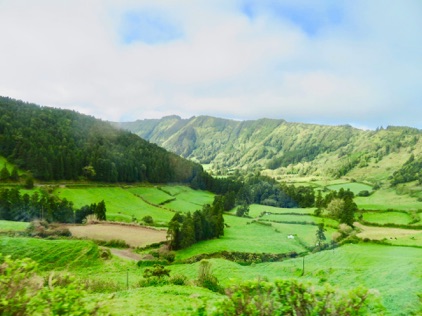
left:The bus took us westwards on the R1-1A through a lot of green fields, hills, and mountains.
We drove through Ginetes, Varzia, and finally arrived at our destination; Sete Cidades, the largest town on the shores of the Lagoa Azul, the Blue Lake. This Lake is connected to the Lagoa Verde, the Green Lake, and together these two crater lakes are the top tourist attraction of the island. The weather was unfortunately not very cooperative that day; it was overcast and misty. On good day we would have been able to see these two lakes clearly with the different colors next to each other.
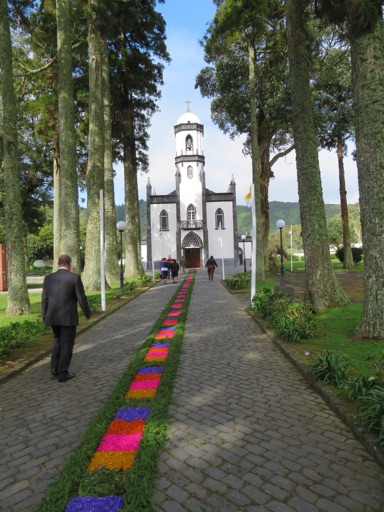
right: The church of São Nicolau.
Our first stop in Sete Cidades was the small church of São Nicolau. Located in a very peaceful location, we walked through a path lined with beautiful cryptomeria trees, which came from Japan, headed by two large araucarias. It was Easter Sunday today, and the path to the church had been adorned with colorful chips.
The inside of the church was beautiful, simple, and quiet, because we were very early and the congregation was just trickling in to celebrate Easter. The Church is Neolithic in style; it was built in the 19th century, becoming the seat of curatorship and parish in the second half of the 20th century. The order to build the church came from Colonel Nicolau Maria Raposo Amaral (1770-1865). In 1969, the church was donated by the heirs to the people, and it become the parish seat that same year.
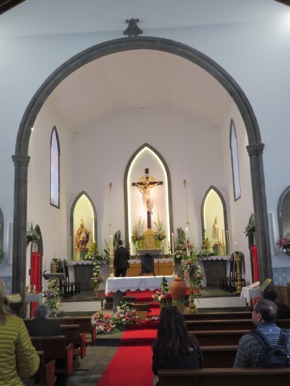
left: The Altar.
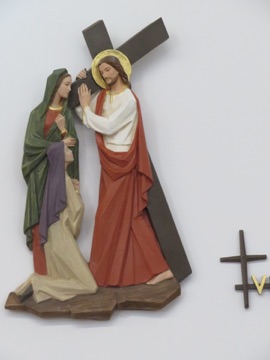
right: One of the very modern depictions of the Twelve Stations of the Cross.
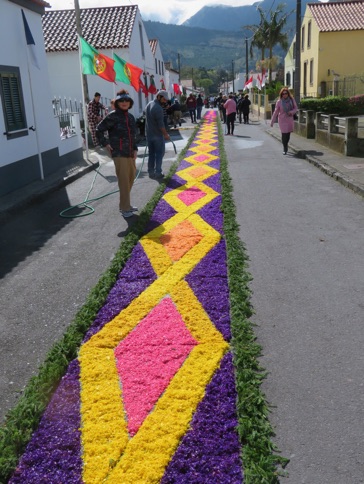
left: The villagers were decorating their main streets with colored leaves and chips to celebrate Easter.
We then walked to the village, where the inhabitants were busily adorning their main street with colored leaves and stuff to celebrate Easter.
From there we drove to the highlight of the island, the adjoining lakes of Lagoa Azul and Lagoa Verde. The bus took us on the road between the two bodies of water and then in the hills around the two lakes. The lake furthest away is Lagoa Azul, and the little town of Sete Cidades can be seen in the haze on the left side of the blue lake. The lake closest by is Lagoa Verde, where the water is green.
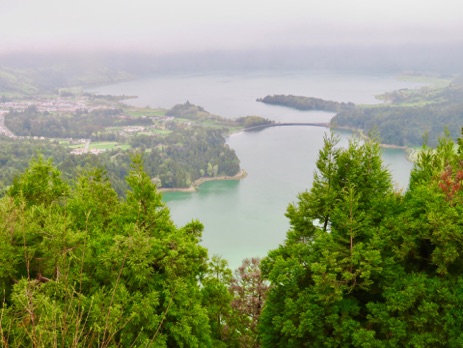
right: Lagoa Azul and Lagoa Verde, the top attraction of the island.
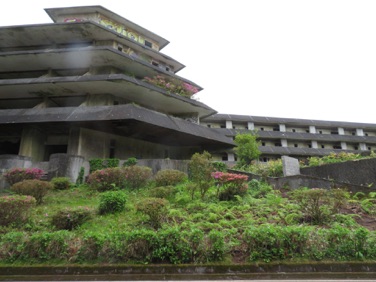
On the top of a hill, where we were standing making this picture with sweeping views of the two lakes is this large, abandoned, hotel with 100+ rooms. The original developers went bankrupt, and the site has just been purchased by a Chinese group the revive the resort.
We drove back to Ponta Delgada and were dropped off at a large building where we had lunch; actually a tasting of the red and white local wines and the large selection of cheeses produced on the island.
We were dropped off at the ship but I decided to take a walk to see more of the city. I walked along the quay until I came to the town square shown below.
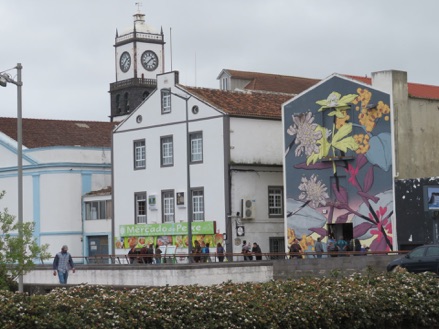
left: I thought it was cool to see this huge floral painting on the wall of the building, next to a seafood market.
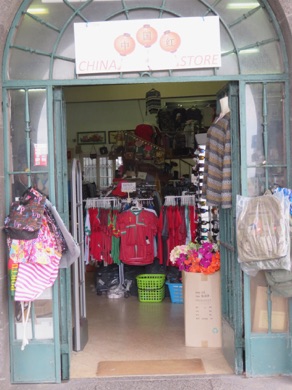
left: And here was a Chinese store
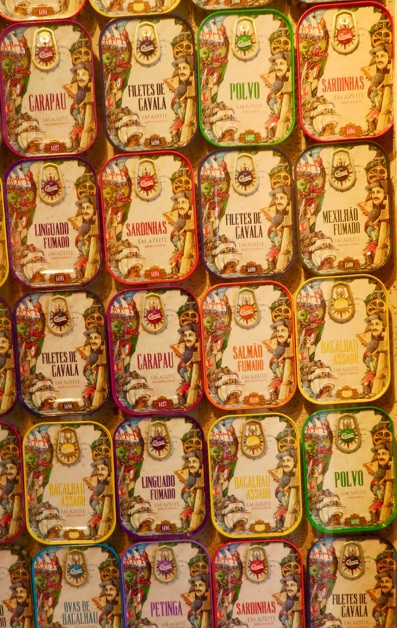
right; you see the huge variety of tinned seafood in olive oil on display in some shops.
Tinned seafood is a common staple in Portugal and there are shops everywhere selling these products. Not only sardines (sardinhas), but also fillet of mackerel (filete de cavala), octopus (polvo), smoked salmon (salmão fumado), baked cod fish (bacalhau assado), smoked mussels (mexilhão fumado), horse mackerel (carapau), smoked sole (linguado fumado), etc.
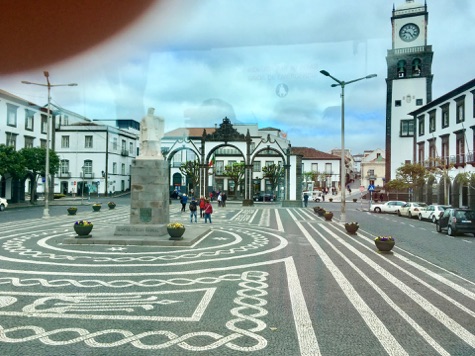
left: One of the main squares in town, the Portas da Cidade (City Gates)
In the afternoon, we walked out of the ship to the large adjacent quay, where there were lots of cafés, shops, etc. to sit down for a beer.
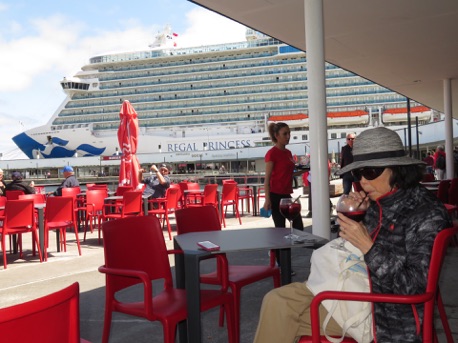
And so we sat there and just enjoyed the view of the ship and the harbor over a jug of sangria. That was very nice.
Tuesday, June 12, 2012